
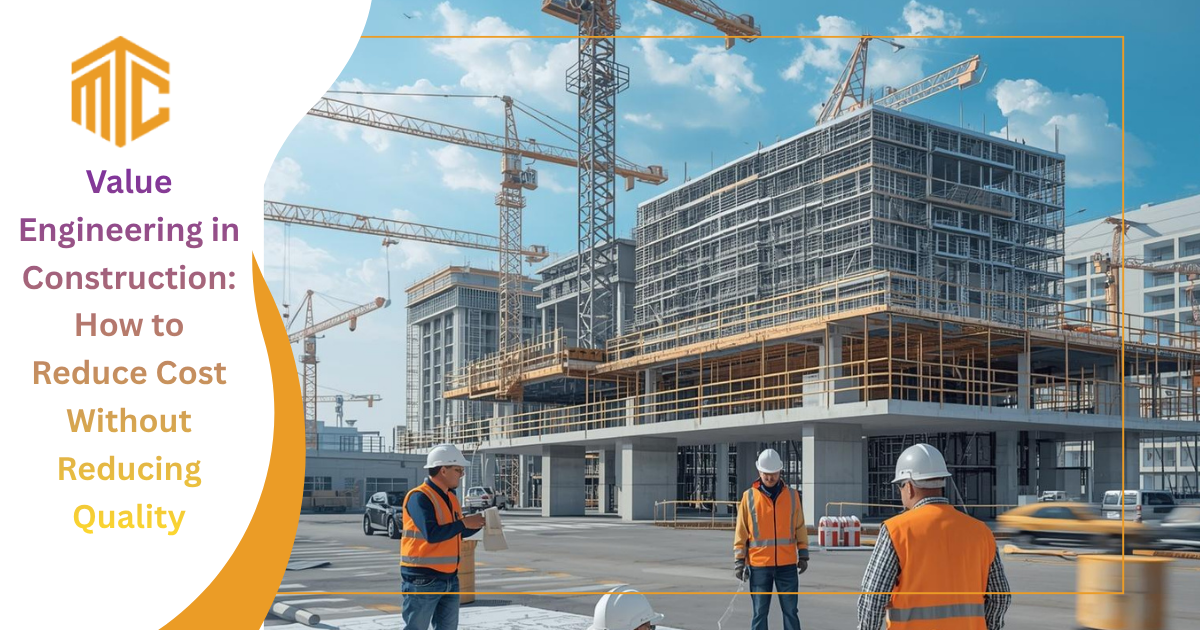
Rising construction costs around the world are making it harder for projects to stay within budget while still meeting quality standards. Many developers face the challenge of cutting expenses without lowering performance or durability. Value Engineering (VE) offers a smart solution by focusing on efficiency and better design choices. It is important to understand that VE does not mean making a project cheaper in a negative way. Value Engineering with MTC helps reduce costs while maintaining or even improving overall quality.
Value engineering is becoming an important part of modern construction projects. It aims at adding value to projects by searching for smarter solutions to design, material and resource management without compromising quality. With the ever-increasing cost of construction, value engineering is being used to help companies remain cost effective and competitive.
It promotes collaboration between engineers, architects and contractors to find better options. This process helps in quicker decision-making with the assistance of new technologies and data analysis. It is no longer a cost-cutting tool but a strategic tool that enhances performance, sustainability and overall project success in the construction industry today.
Significant Benefits of Value Engineering in Construction
Cost Efficiency
It helps reduce unnecessary expenses by analyzing every part of a project. It ensures that money is spent only where it adds real value. By choosing cost-effective materials and methods, projects stay within budget without affecting the outcome or overall quality.
Improved Project Quality
Instead of lowering standards, value engineering focuses on enhancing quality. It identifies better design options and construction methods that improve durability and performance. This approach ensures that the final structure is strong, reliable, and meets all required standards and expectations.
Better Resource Utilization
This method promotes the efficient use of materials, labor, and time. It minimizes waste by selecting optimal solutions for construction processes. This leads to better planning and execution, ensuring that all resources are used wisely without unnecessary consumption or delays.
Enhanced Decision-Making
Through detailed analysis and teamwork, this method improves decision-making. It allows project teams to compare different options and select the best one. This reduces risks and ensures that decisions are based on value, performance, and long-term benefits.
Ways Value Engineering Helps to Cut Cost Without Reducing Quality
Optimizing Design Solutions
This process reviews design plans to find simpler and more efficient alternatives. It eliminates extraneous complexities and remains functional. This will decrease the cost of construction and accelerate the process without affecting the strength, safety or even the usability of the structure.
Selecting Cost-Effective Materials
It involves the selection of materials with similar performance at a reduced price. Comparison of alternatives allows engineers to use materials that are cheap, durable and fitting the project, maintain quality and save on the overall cost.
Improving Construction Methods
This method proposes superior construction methods which conserve time and effort. The effective practices minimize wastage of time and manpower, but the quality remains high. This leads to the implementation of the project being smoother and there is no compromise in quality to implement the project faster or to save.
Reducing Material Waste
Proper planning can reduce wastage of materials in the construction process. Value engineering helps to find methods of using materials more productively, which reduces the costs and helps sustainability. Reduced wastage translates to enhanced costs control and yet the quality of the project intended is achieved.
Enhancing Project Planning
Good planning eliminates mistakes and repetitions that can be costly. Value engineering enhances scheduling and coordination whereby tasks are done well the first time. This saves on unnecessary expenses and ensures that the project is on track as per quality standards and schedule.
Encouraging Team Collaboration
It gathers various professionals to exchange ideas and come up with superior solutions. Teamwork results in new ways of doing things that are cost effective and enhance results. The project takes advantage of different views with all parties involved without suffering quality.
Focusing on Life-Cycle Costs.
It does not focus on the immediate costs but focuses on the long-term costs such as maintenance and operation costs. In selecting efficient and durable solutions, it minimizes future payments but at the same time makes the structure reliable and of high quality in time.
Major Challenges in Implementing Value Engineering
The introduction of value engineering in the construction industry is quite challenging because of several aspects. Resistance to change is one of the biggest problems because stakeholders might be inclined to use traditional approaches. The absence of awareness and knowledge of value engineering concepts can be a limiting factor as well. During planning of projects, time is a major constraint since detailed analysis may not be possible.
Also, implementation may be ineffective due to poor communication among team members. In some cases, a myth exists that value engineering is just a cost-cutting exercise, which evokes reluctance. Poor skills and training only contribute to the challenge. To beat these difficulties, appropriate education, teamwork, and a long-term value focus are needed.
Following Best Practices for Successful Value Engineering
Start VE Early in the Design Phase
This method begins in the early design phase and enables a team to look at a variety of options before decisions start being made. It helps in reducing expensive modifications in the future and is more effective in incorporating ideas. Early engagement brings about flexibility, efficiency and overall, more practical, cost-effective project deliverables.
Involve All Stakeholders
Involving all the stakeholders in the process will guarantee that various views are taken into consideration. Valuable insights can be shared between designers, engineers, clients, and contractors. This partnership enhances effective communication, reduces misunderstandings and helps in developing balanced solutions.
Use Data-Driven Decision-Making
Correct data help the teams to make effective and sound decisions in value engineering. Clearly, cost estimates, performance measures, and risk analysis give clear guidance. This will minimize the level of guesswork, a high level of confidence in the solutions, and the decisions made are not made based on assumptions or personal views but based on facts.
Encourage Innovation
Creative thinking should be encouraged to enable teams to find new and improved means of accomplishing project objectives. This method can beneficially be influenced with new ideas and approaches. Encouraging innovation establishes a free atmosphere in which the team members feel free to give suggestions that may help in enhancing the quality, lowering the cost and increasing the overall value.
Organize VE Workshops on Regular Basis
Regular value engineering workshops can be used to keep focus and progress in the project. These meetings unite teams to share ideas, discuss problems and assess options. Regular meetings guarantee the constant enhancement and enable adjusting in time, keeping the project in line with its initiatives of value.
Document And Track Results
To ensure accountability and learning, it is crucial to record all the activities and results. Effective documentation aids in monitoring the decisions, savings, and continuous improvements. It also serves as a good point of reference to future projects where teams can use effective strategies and learn not to make the same mistakes as before.
Pay Attention to Lifecycle Value and not Cost
Looking at the complete lifecycle of a project means a higher value in the long run. Teams ought not to consider the initial costs only but also consider the maintenance, operation, and durability. This strategy results in more smart decisions that will lower overall costs in the long term and enhance performance, sustainability, and user satisfaction.
Building Smarter: The True Value of Value Engineering
In conclusion, value Engineering plays a key role in modern construction by improving efficiency without lowering quality. It focuses on long-term value, not just short-term savings. Companies like MTC apply VE to achieve better results. Adopting this approach leads to smarter decisions and more successful projects.
Frequently Asked Questions
Does Value Engineering reduce quality?
No, it aims to maintain or enhance quality while eliminating inefficiencies.
When should Value Engineering be applied?
It is most effective during the early design phase of a project.
Who is involved in Value Engineering?
Architects, engineers, contractors, and stakeholders collaborate in the VE process.
What are common VE techniques?
Material substitution, design simplification, prefabrication, and lifecycle cost analysis.