
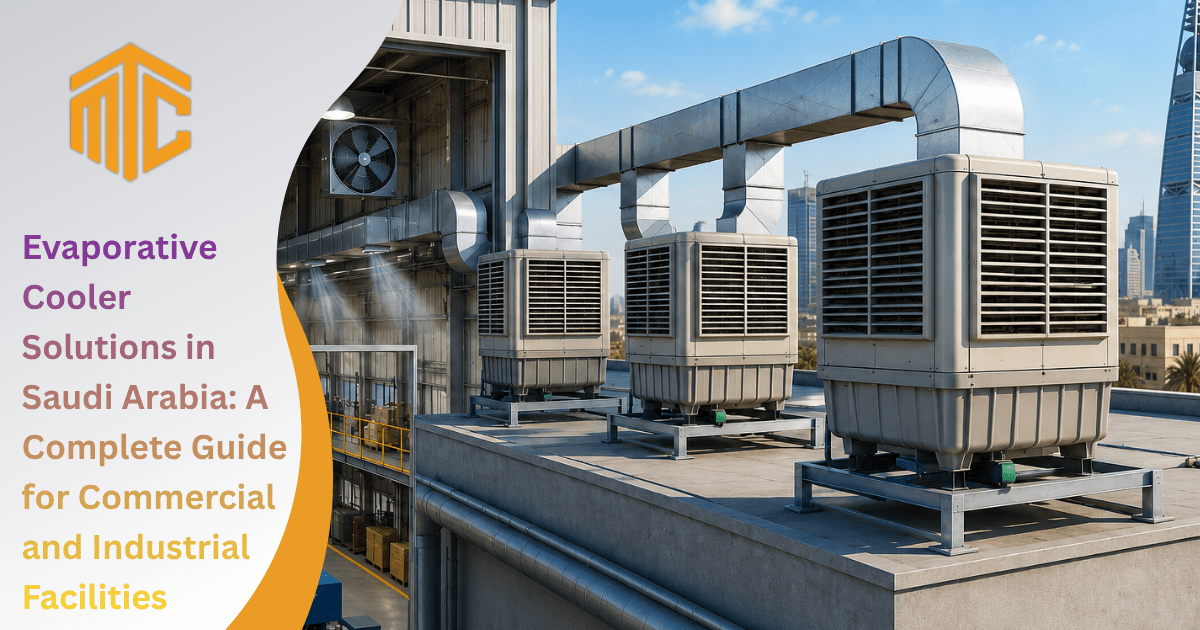
Cooling is essential for commercial and industrial facilities operating in Saudi Arabia’s hot climate. High temperatures can affect employee comfort, equipment performance, and overall productivity while increasing energy costs. As businesses look for more efficient and cost-effective cooling solutions, evaporative coolers have become a preferred choice for factories, warehouses, workshops, logistics centers, and other large facilities.
Unlike conventional air conditioning systems, evaporative coolers use the natural process of water evaporation to deliver fresh, cool air with significantly lower energy consumption. This guide explains how evaporative cooling works, its key benefits, common applications, and why it is an effective cooling solution for commercial and industrial facilities across Saudi Arabia.
Why Businesses in Saudi Arabia Need Energy-Efficient Cooling
Saudi Arabia experiences high temperatures for much of the year, making cooling systems an essential part of daily operations for many businesses. Industrial facilities, warehouses, factories, commercial buildings, and logistics centers often operate for extended hours, causing traditional air conditioning systems to consume substantial amounts of electricity.
While conventional cooling systems perform well in enclosed spaces, they can become expensive to operate in large or semi-open environments. High electricity consumption, increasing maintenance costs, and limited fresh air circulation are common challenges faced by facility managers.
Evaporative cooling addresses these challenges by providing continuous airflow, reducing indoor temperatures, and consuming significantly less energy. Because Saudi Arabia has a predominantly hot and dry climate, evaporative cooling systems operate under ideal environmental conditions, making them both effective and economical for commercial and industrial applications.
An evaporative cooler, also known as a desert cooler, is a cooling system that lowers air temperature through the natural process of water evaporation. Instead of using refrigerants and compressors, the system passes warm outdoor air through water-saturated cooling pads. As the water evaporates, it absorbs heat from the incoming air, producing a continuous flow of cooler and fresher air.
Unlike traditional air conditioning systems that recirculate indoor air, evaporative coolers continuously introduce fresh outdoor air into the building. This improves ventilation while reducing heat buildup, creating a healthier and more comfortable environment for employees and visitors.
Because the cooling process relies on evaporation rather than refrigeration, evaporative coolers require fewer mechanical components. This results in lower electricity consumption, simpler maintenance, and improved operational reliability.
How Does an Evaporative Cooling System Work?
Although the technology is straightforward, it provides highly effective cooling for large facilities.
The process begins when warm outdoor air is drawn into the cooling unit through specially designed cooling pads. These pads remain saturated with water using an integrated circulation system. As the incoming air passes through the wet media, water evaporates and absorbs heat from the air.
A high-capacity fan then distributes the cooled air throughout the building while continuously introducing fresh outdoor air.
The cooling process can be summarized as follows:
- Warm outdoor air enters the cooling unit.
- Water-saturated cooling pads absorb heat through evaporation.
- Air temperature decreases naturally.
- High-volume fans distribute cooled air throughout the facility.
- Fresh air replaces stale indoor air to improve ventilation.
Because this system operates without compressors, it consumes considerably less electricity than conventional air conditioning while maintaining effective cooling performance in large spaces.
Benefits of Evaporative Coolers for Commercial and Industrial Facilities
Lower Energy Consumption
One of the primary reasons businesses choose evaporative cooling is its exceptional energy efficiency. Conventional air conditioning systems depend on compressors, which are among the highest consumers of electricity in commercial buildings.
Evaporative coolers, by comparison, use only a fan, water pump, and cooling media to reduce air temperature. This simple operating principle allows facilities to achieve effective cooling while significantly lowering energy consumption.
For factories, warehouses, production plants, and logistics centers that operate throughout the day, reduced electricity usage can lead to substantial long-term savings.
Continuous Fresh Air Ventilation
Indoor air quality plays an important role in maintaining a healthy and productive working environment. Traditional air conditioning systems often recirculate the same indoor air, whereas evaporative cooling systems continuously introduce filtered outdoor air.
This constant airflow helps remove heat, dust, odors, and airborne contaminants while maintaining comfortable indoor conditions. Improved ventilation is particularly beneficial for manufacturing facilities, workshops, and warehouses where heat and airborne particles are common.
The result is a fresher indoor environment that supports employee comfort and operational efficiency.
Reduced Operating Costs
Energy savings directly contribute to lower operating expenses, but they are not the only financial benefit.
Evaporative cooling systems generally require fewer mechanical components than traditional air conditioning systems. Without compressors or complex refrigeration circuits, maintenance requirements are often simpler and less expensive.
Over the lifetime of the system, businesses can benefit from:
- Lower electricity bills.
- Reduced maintenance costs.
- Longer equipment life.
- Lower repair expenses.
- Improved return on investment.
These advantages make evaporative coolers an attractive option for organizations looking to improve operational efficiency while controlling long-term facility costs.
Environmentally Responsible Cooling
Sustainability has become an important consideration for businesses across Saudi Arabia. Organizations are increasingly seeking technologies that reduce energy consumption while supporting environmental goals.
Evaporative cooling systems use water as the primary cooling medium and require little or no refrigerants. Their lower electricity demand also contributes to reduced carbon emissions compared to conventional cooling systems.
As Saudi Arabia continues to promote sustainable development through Vision 2030, energy-efficient cooling technologies are becoming an important part of responsible facility management.
Reliable Cooling for Large Commercial and Industrial Facilities
Cooling large spaces efficiently is often one of the biggest challenges for commercial and industrial businesses. Conventional air conditioning systems are generally designed for enclosed environments and may struggle to maintain consistent temperatures in facilities with high ceilings, open layouts, or frequent door openings. These conditions can lead to uneven cooling, higher energy consumption, and increased operating costs.
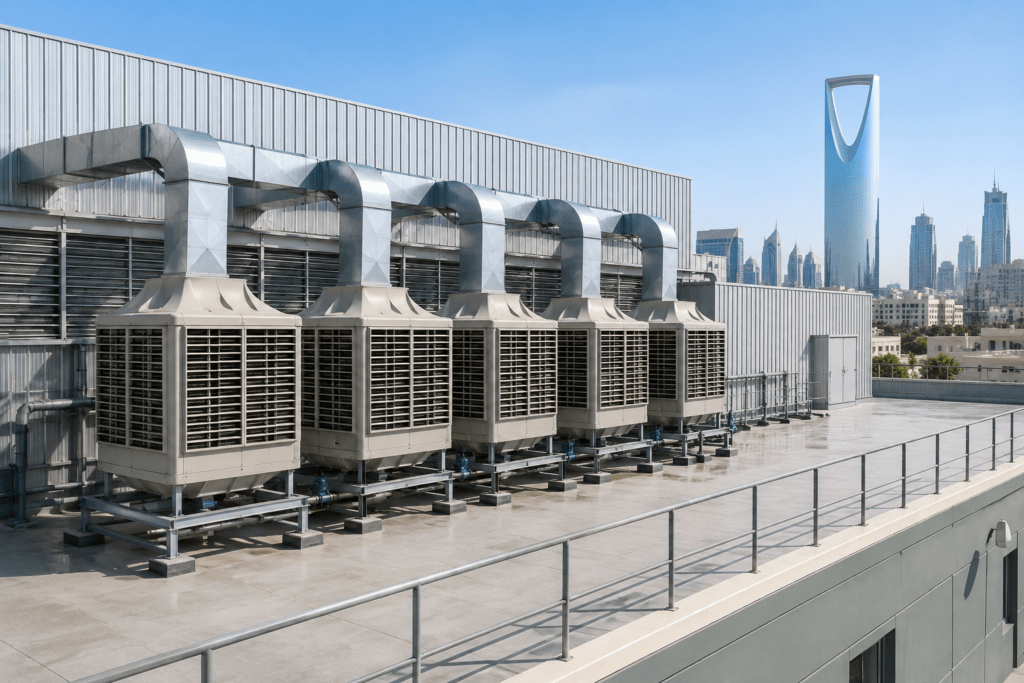
Evaporative coolers are specifically designed to address these challenges by delivering high volumes of cooled fresh air throughout large areas. Whether installed in a manufacturing plant, warehouse, logistics center, or workshop, they help maintain comfortable working conditions while reducing the energy required to cool expansive spaces. This makes evaporative cooling a practical and economical solution for businesses seeking reliable performance throughout the year.
Commercial vs. Industrial Evaporative Coolers
Although both systems operate using the same cooling principle, they are designed to meet different operational requirements.
Feature | Commercial Evaporative Cooler | Industrial Evaporative Cooler |
Application | Offices, retail stores, restaurants, schools | Factories, warehouses, workshops, logistics centers |
Cooling Capacity | Moderate | High airflow for large spaces |
Operating Hours | Standard business hours | Continuous or extended operation |
Installation | Portable, wall-mounted, or roof-mounted | Ducted, roof-mounted, or centralized systems |
Primary Objective | Occupant comfort | Process cooling and workplace efficiency |
Choosing between commercial and industrial systems depends on factors such as facility size, airflow requirements, occupancy, and operational demands. A professional assessment ensures the selected system delivers optimal cooling performance while maintaining energy efficiency.
Applications Across Industries in Saudi Arabia
Evaporative cooling systems are widely used across multiple industries because they provide efficient cooling for large and demanding environments. Their ability to supply continuous fresh air while maintaining lower operating costs makes them suitable for a variety of commercial and industrial applications.
Common industries include:
- Manufacturing plants and production facilities
- Warehouses and distribution centers
- Logistics and transportation hubs
- Automotive workshops and service centers
- Agricultural buildings and livestock facilities
- Retail stores and shopping centers
- Sports facilities and event venues
- Educational institutions
- Mosques and community halls
Each facility has unique cooling requirements, and selecting the right evaporative cooling system helps improve comfort, operational efficiency, and energy performance.
Choosing the Right Evaporative Cooler
Selecting the right evaporative cooler involves more than choosing a unit with the highest airflow capacity. Every facility has different operational requirements, building layouts, and ventilation needs that influence system performance.
Before selecting a system, businesses should evaluate:
- Building size and ceiling height
- Airflow requirements (CFM)
- Indoor or outdoor installation
- Existing ventilation system
- Water supply availability
- Energy efficiency goals
- Future expansion plans
- Maintenance accessibility
Working with an experienced cooling solutions provider ensures the system is properly sized and configured for maximum efficiency. A well-designed installation not only improves cooling performance but also extends equipment life and reduces long-term operating costs.
Maintenance Best Practices
Like any mechanical system, evaporative coolers perform best when they are regularly maintained. Routine inspections help maintain cooling efficiency, improve reliability, and reduce unexpected downtime.
A preventive maintenance program should include:
- Cleaning or replacing cooling pads when required.
- Inspecting water pumps and circulation systems.
- Cleaning the water reservoir to prevent mineral buildup.
- Checking fans and motors for smooth operation.
- Inspecting ductwork for unrestricted airflow.
- Monitoring water quality and drainage systems.
- Scheduling professional servicing at regular intervals.
Consistent maintenance helps ensure reliable performance while maximizing the lifespan of the cooling system.
Why Choose Multi Tech for Evaporative Cooler Solutions?
Choosing the right cooling system is only part of the solution. Proper system design, equipment selection, and professional installation are equally important for achieving reliable long-term performance.
Multi Tech provides complete evaporative cooler solutions for commercial and industrial facilities across Saudi Arabia. From initial consultation and system design to installation and ongoing support, our team works closely with clients to deliver cooling systems that match their operational requirements and energy efficiency objectives.
Whether the project involves a manufacturing plant, warehouse, logistics center, commercial building, or industrial workshop, Multi Tech focuses on providing practical cooling solutions that improve workplace comfort, reduce operating costs, and support sustainable business operations.
Final Thoughts
Evaporative coolers have become one of the most effective cooling solutions for commercial and industrial facilities in Saudi Arabia. Their ability to deliver continuous fresh air, lower energy consumption, and reliable cooling makes them particularly well suited to the Kingdom’s hot and dry climate.
For businesses seeking an economical alternative to conventional air conditioning, evaporative cooling offers long-term value through lower operating costs, improved indoor air quality, and enhanced workplace comfort. When designed and installed correctly, these systems help organizations improve operational efficiency while supporting their sustainability and energy management goals.
Frequently Asked Questions
What is an evaporative cooler?
An evaporative cooler is a cooling system that lowers air temperature by passing warm outdoor air through water-saturated cooling pads. The natural evaporation process produces cooler air while continuously supplying fresh air to the building.
Are evaporative coolers suitable for Saudi Arabia?
Yes. Saudi Arabia’s hot and generally dry climate provides ideal conditions for evaporative cooling, making these systems highly effective for factories, warehouses, workshops, commercial buildings, and other large facilities.
Where are evaporative coolers commonly used?
Evaporative coolers are widely used in manufacturing plants, warehouses, logistics centers, workshops, agricultural facilities, retail buildings, sports complexes, educational institutions, and other commercial or industrial environments requiring efficient cooling.
What are the benefits of an evaporative cooler?
Key benefits include lower energy consumption, reduced operating costs, continuous fresh air ventilation, improved indoor air quality, environmentally responsible operation, and effective cooling for large commercial and industrial spaces.
Why choose Multi Tech for evaporative cooler solutions in Saudi Arabia?
Multi Tech provides end-to-end evaporative cooling solutions, including system design, equipment selection, professional installation, and technical support. Our experienced team delivers customized cooling systems that improve efficiency, reduce energy costs, and meet the operational needs of commercial and industrial facilities across Saudi Arabia.