
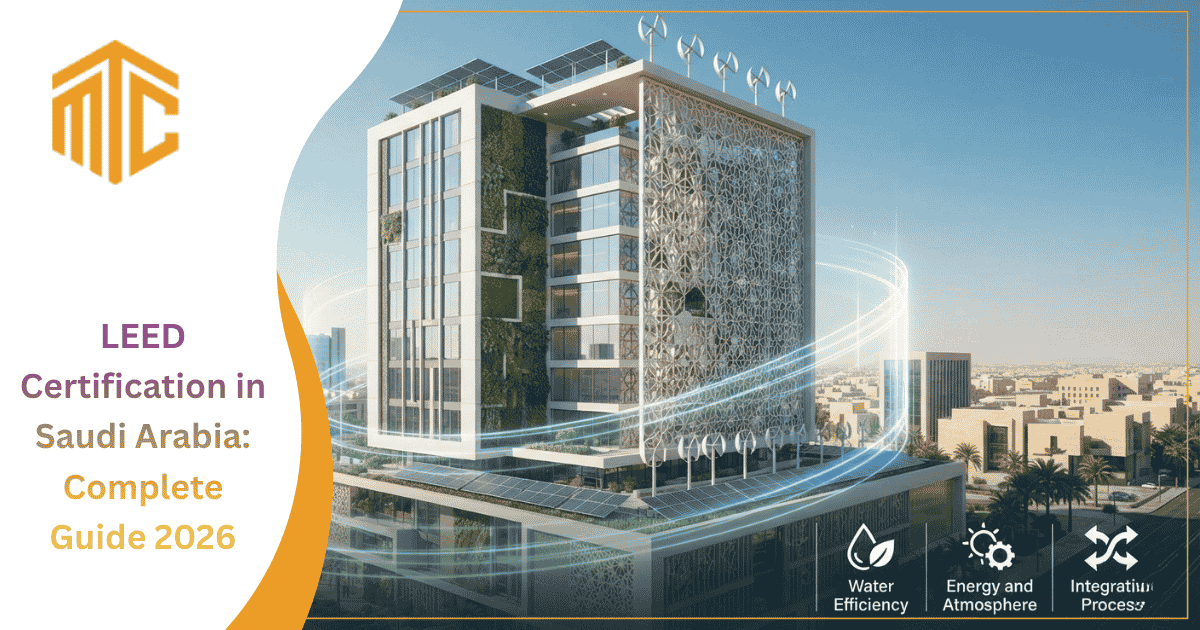
Saudi Arabia’s construction industry is going through a genuine shift. Under Vision 2030, sustainability has moved from a nice-to-have talking point to an actual requirement for major developments, and green building certification has become one of the clearest ways for developers, architects, and contractors to prove they’ve met that standard. Among the available certification frameworks, LEED remains the most internationally recognized. This guide covers what LEED certification in Saudi Arabia actually involves, how it compares to region-specific alternatives like Mostadam and GSAS, and what it takes to achieve it on a Saudi project.
LEED, which stands for Leadership in Energy and Environmental Design, is a green building rating system developed by the U.S. Green Building Council (USGBC) and administered globally by the Green Business Certification Inc. (GBCI). It evaluates buildings against a points-based framework covering energy performance, water efficiency, materials selection, indoor environmental quality, and sustainable site design. Projects that meet enough criteria earn one of four certification levels, and the credential is recognized by investors, tenants, and regulators well beyond the region where a building is located.
Saudi Arabia’s climate makes energy efficiency a genuinely practical concern, not just an environmental one. Cooling demand dominates energy consumption in commercial buildings for much of the year, which means the efficiency gains built into green certification standards translate directly into lower operating costs. Beyond the operational savings, certified buildings increasingly command higher rents, attract more serious investors, and align directly with Vision 2030’s sustainability goals. A factor that carries real weight for developers pursuing government-linked or giga-project work across NEOM, the Red Sea, and similar developments.
LEED Certification Levels
LEED certification is awarded across four tiers, based on the total number of points a project earns across its credit categories:
- Certified — the entry-level tier, meeting baseline sustainability requirements
- Silver — a moderate level of additional achievement beyond the baseline
- Gold — a strong sustainability performance, common among ambitious commercial projects
- Platinum — the highest tier, reserved for projects demonstrating exceptional performance across nearly every credit category
Most commercial projects in Saudi Arabia target Gold as a realistic, market-differentiating benchmark, though flagship developments increasingly pursue Platinum for maximum reputational and marketing value.
The LEED Certification Process: Step by Step
Pursuing LEED certification generally follows a consistent sequence, regardless of project type:
- Select the appropriate rating system — LEED offers different tracks for new construction, core and shell, interior fit-outs, and operations and maintenance, so choosing the right one early avoids wasted documentation effort later.
- Confirm Minimum Program Requirements (MPRs) — baseline eligibility criteria every project must meet before pursuing certification.
- Register the project with GBCI and begin tracking credits against the applicable rating system.
- Design and document credit compliance across categories like energy performance, water use, materials, and indoor air quality, typically with support from a sustainability consultant.
- Submit for review — GBCI reviews the submitted documentation and issues preliminary and then final certification decisions.
- Address any review comments and resubmit documentation where clarification or additional evidence is required.
Working with an experienced LEED certification consultant at this stage significantly reduces the back-and-forth that often slows down projects attempting the process without dedicated expertise.
Key LEED Credit Categories
LEED points are distributed across several credit categories, each addressing a different dimension of building performance:
- Energy and Atmosphere — energy efficiency, renewable energy use, and building system performance
- Water Efficiency — indoor and outdoor water use reduction, a particularly relevant category in Saudi Arabia’s arid climate
- Sustainable Sites — site selection, stormwater management, and reducing heat island effect
- Materials and Resources — sourcing, recycled content, and construction waste management
- Indoor Environmental Quality — air quality, lighting, thermal comfort, and occupant health
- Innovation — credit for design strategies or technologies that go beyond standard requirements
Energy and water efficiency credits tend to carry particular weight for Saudi projects, given the climate-driven cooling loads and the national emphasis on water conservation.
LEED vs Other Green Building Standards in Saudi Arabia
LEED isn’t the only certification option available to Saudi developers, and understanding how it compares to regional alternatives helps in choosing the right framework for a specific project.
Mostadam is Saudi Arabia’s own national green building rating system, developed specifically to reflect local climate conditions, building codes, and Vision 2030 sustainability priorities. For projects seeking direct alignment with national programs and regulatory recognition, Mostadam is often a natural fit.
GSAS (Global Sustainability Assessment System), developed in the Gulf region, similarly reflects regional climate and construction practices, making it a common choice for projects across the GCC.
BREEAM, developed in the UK, is another internationally recognized framework with a strong presence in commercial real estate globally.
Estidama, developed in Abu Dhabi, is region-specific like Mostadam and GSAS.
LEED’s main advantage remains its global recognition, particularly valuable for developments seeking international investment, multinational tenants, or cross-border reputation. Many Saudi projects now pursue LEED alongside Mostadam, satisfying both international market expectations and local regulatory alignment simultaneously. Multi Tech’s green building certification services cover LEED, BREEAM, GSAS, and Estidama, helping project teams decide which framework or combination fits their specific goals.
Beyond the sustainability credentials themselves, LEED certification delivers measurable business advantages. Certified buildings typically see lower utility costs from energy and water efficiency improvements. Market data consistently shows certified properties commanding higher rents and stronger occupancy compared to uncertified peers. For developers working on government-linked projects, certification also demonstrates direct alignment with Vision 2030’s environmental targets, which increasingly factors into project approval and investment decisions.
Challenges of Achieving LEED Certification in Saudi Arabia's Climate
Saudi Arabia’s climate does introduce specific challenges to the certification process. Extreme heat drives cooling loads that require careful HVAC design to meet energy efficiency credit thresholds. Water scarcity makes the water efficiency category especially demanding, requiring genuinely efficient fixtures and landscaping strategies rather than token gestures. Sourcing regionally available, sustainable materials that also meet LEED’s materials credit requirements can require more design flexibility than in markets with a more mature green materials supply chain. Working with consultants experienced specifically in Saudi conditions, not just LEED generally, makes a meaningful difference in navigating these challenges efficiently.
Navigating LEED’s documentation requirements, credit selection, and GBCI review process is considerably smoother with experienced local guidance. Multi Tech provides end-to-end LEED certification consulting for developers, architects, and contractors across Saudi Arabia from initial rating system selection through documentation, audit preparation, and final certification submission alongside broader green building certification services covering LEED, BREEAM, GSAS, and Estidama.
Conclusion
LEED certification offers Saudi developers a globally recognized way to demonstrate energy efficiency, sustainability, and Vision 2030 alignment, alongside measurable savings in operating costs and stronger market positioning. Understanding how it compares to regional frameworks like Mostadam and GSAS helps project teams choose the right certification path or combination of paths for their specific goals. With experienced consulting support, the certification process becomes a manageable, well-documented path rather than an administrative burden.
Frequently Asked Questions
How long does LEED certification typically take to achieve?
Timelines vary by project size and rating system, but most projects take several months to over a year from registration through final certification, depending on documentation readiness and design complexity.
Is LEED certification recognized in Saudi Arabia alongside Mostadam?
Yes — many Saudi projects pursue LEED alongside Mostadam, satisfying both international recognition and national regulatory alignment simultaneously.
What LEED certification level should a typical commercial project in Saudi Arabia target?
Gold is a common, realistic benchmark for ambitious commercial projects, while flagship developments increasingly pursue Platinum for maximum reputational value.
Why is water efficiency such a significant LEED credit category in Saudi Arabia?
Given the region’s water scarcity, efficient indoor and outdoor water use is both an environmental priority and a practical necessity, making this credit category especially demanding for local projects.