
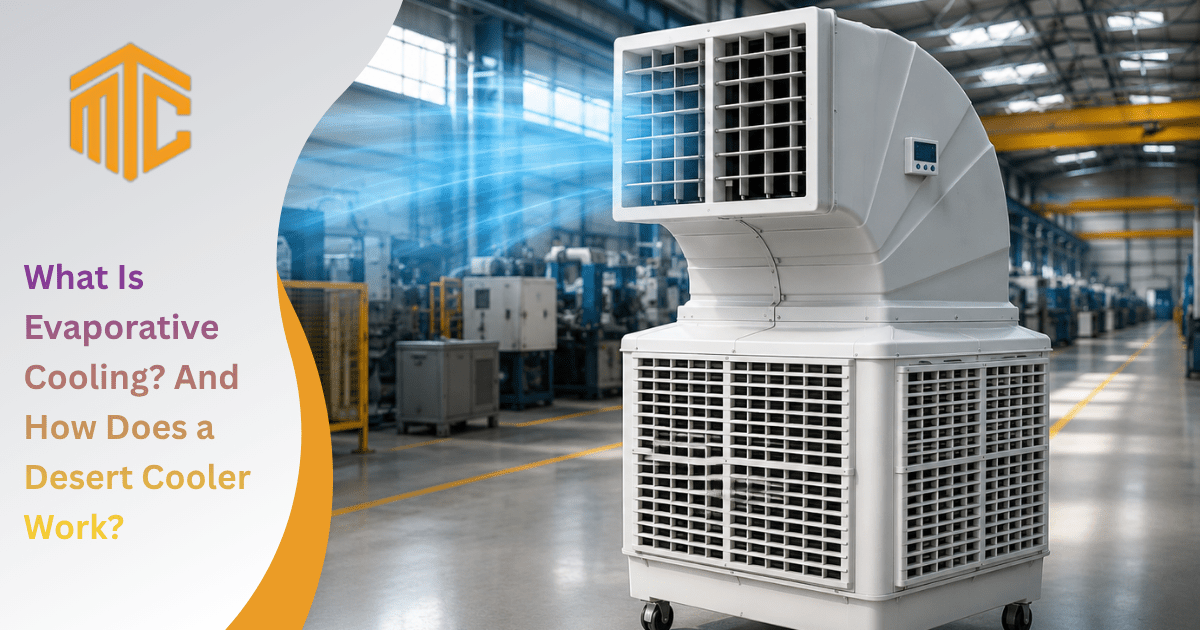
When temperatures rise in Saudi Arabia, factories, warehouses, workshops, and commercial spaces need effective cooling solutions that can manage large areas efficiently. Evaporative cooling uses the natural process of water evaporation to reduce air temperature and provide a continuous supply of cooler air. Also known as a desert cooler, air cooler, or evaporative air conditioner, this system can be a practical option for large, well-ventilated spaces, particularly in hot and relatively dry climates. Understanding how an evaporative cooler works can help businesses determine whether it is the right cooling solution for their facility.
Evaporative cooling is a cooling process that lowers air temperature by passing warm air through water-saturated cooling media. As the water evaporates, it absorbs heat from the air, producing cooler supply air.
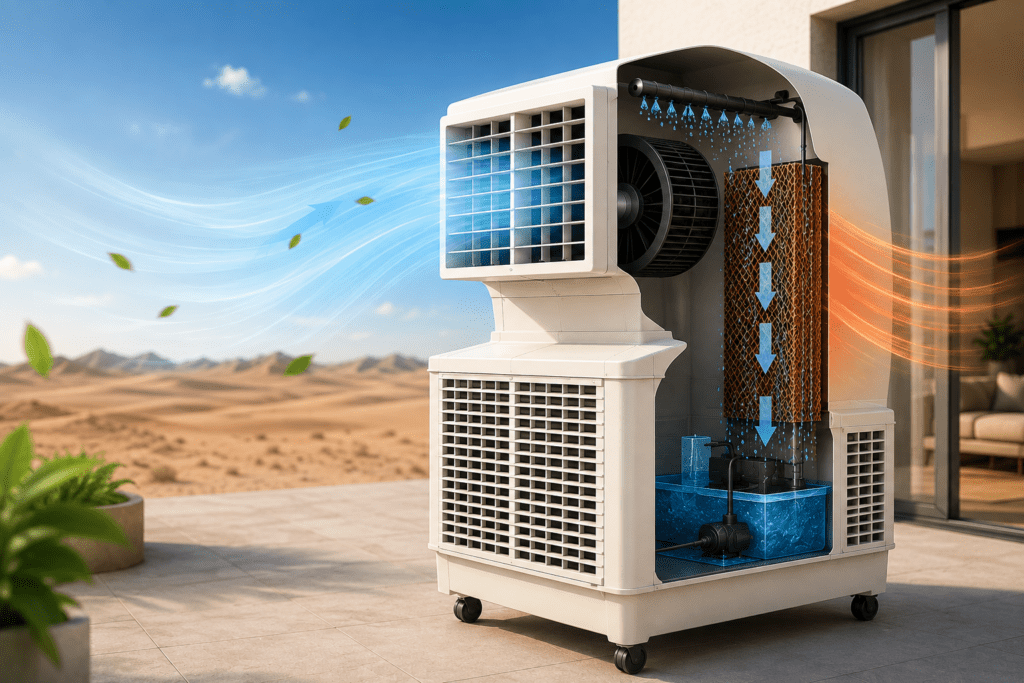
A typical evaporative cooler includes:
- Fan or blower
- Water pump
- Cooling pads
- Water distribution system
- Water tank or reservoir
- Air intake and discharge
- Control system
Unlike traditional air conditioning, an evaporative cooling system does not rely on the same refrigeration cycle used by conventional air conditioners. Instead, it uses airflow and water evaporation to provide cooling.
A desert cooler operates through a simple cooling process:
Warm Air Enters
The fan draws warm outdoor air into the evaporative air cooler.
Air Passes Through Wet Pads
Water is distributed across the cooling pads, keeping them continuously wet as air passes through.
Water Evaporates
The water absorbs heat from the incoming air as it evaporates.
Air Temperature Drops
The heat transfer reduces the temperature of the air.
Cool Air Is Distributed
The fan delivers the cooled air into the required space. For large facilities, the air may also be distributed through a ducted system.
What Is the Difference Between an Evaporative Cooler and a Regular Air Conditioner?
An evaporative cooler uses water evaporation to cool air, while a traditional air conditioner uses a refrigeration cycle to remove heat.
Feature | Evaporative Cooler | Traditional Air Conditioner |
Cooling method | Water evaporation | Refrigeration |
Compressor | Generally not required | Required |
Refrigerant | Not required for direct evaporative cooling | Required |
Electricity use | Generally lower | Generally higher |
Humidity | Adds moisture | Usually removes moisture |
Large open spaces | Often suitable | Can be costly to cool |
Best conditions | Hot and relatively dry | Wider range of conditions |
Neither technology is automatically better. The right choice depends on climate, humidity, building type, heat load, ventilation, and indoor environmental requirements.
Why Is Evaporative Cooling Suitable for Saudi Arabia?
Many areas of Saudi Arabia experience very high summer temperatures combined with relatively dry conditions. These conditions can make evaporative cooling systems suitable for large industrial and commercial applications.
They can provide high-volume airflow while potentially consuming less electricity than conventional refrigeration-based cooling. However, performance decreases as humidity increases, so a professional assessment is important before selecting an evaporative cooling system.
Where Are Industrial Evaporative Coolers Used?
Factories
Evaporative cooling for factories can help manage heat generated by machinery, production processes, lighting, and workers. It can be especially useful in large production halls where fully air-conditioning the entire space may be impractical.
Warehouses
An evaporative cooler for warehouses can provide high-volume airflow in facilities with high ceilings, large doors, and substantial air volumes.
Workshops
Automotive workshops, maintenance areas, fabrication facilities, and other workshops can become extremely hot during summer. An industrial air cooler can provide continuous airflow and cooling where conditions are suitable.
Large Halls
Large halls and other spacious facilities can benefit from high-airflow cooling systems where precise temperature and humidity control are not required.
Farms and Agricultural Facilities
Suitable farms, barns, livestock areas, and agricultural facilities can also use evaporative cooling when ventilation, humidity, and environmental requirements allow.
What Is a Ducted Evaporative Cooling System?
A ducted evaporative cooling system distributes cooled air through ducts instead of releasing it directly from the cooler. This allows cooled air to reach multiple areas or specific zones within a building.
Common searches in this category include:
- Evaporative duct cooler
- Duct air cooler
- Central evaporative air conditioning
- Central evaporative cooling system
- Central desert air conditioner
- Central desert cooler
- Ducted evaporative cooling system
- Evaporative cooling for buildings
Proper duct sizing and airflow design are important because poor distribution can result in uneven cooling and inadequate airflow.
What Are the Benefits of an Evaporative Cooler?
Lower Energy Consumption
An evaporative cooler generally requires less electrical energy than many conventional air-conditioning systems because direct evaporative cooling does not use a refrigeration compressor.
High Airflow
Industrial evaporative coolers can move large volumes of air, making them suitable for factories, warehouses, workshops, and large halls.
Effective in Dry Conditions
Evaporative cooling performs particularly well in hot, dry environments because dry air can absorb more moisture during evaporation.
Suitable for Large Spaces
A commercial evaporative cooler or industrial desert cooler can be considered where cooling a large open area with conventional air conditioning would be expensive.
Fresh-Air Cooling
Evaporative systems can continuously introduce and distribute cooled outdoor air, making them suitable for applications where high ventilation is required.
What Are the Limitations of Evaporative Cooling?
Evaporative cooling is not suitable for every application.
Because the system adds moisture to the air, it may not be appropriate where strict humidity control is required. Its performance also decreases when outdoor humidity is high.
In addition, cooling pads, water pumps, reservoirs, and distribution systems require regular evaporative cooler maintenance to maintain performance and hygiene.
How Do You Choose the Best Evaporative Cooler?
Choosing the best evaporative cooler requires more than comparing advertised airflow rates. Important factors include:
- Building size and volume
- Heat generated inside the facility
- Outdoor temperature and humidity
- Required airflow
- Number of occupants
- Operating hours
- Water availability and quality
- Ducting requirements
- Required indoor temperature
- Maintenance requirements
Professional evaporative cooling system design helps determine the appropriate capacity and configuration for each facility.
How Much Does Evaporative Cooling Cost?
Evaporative cooling cost depends on the size and requirements of the project. Factors such as cooling capacity, number of units, ductwork, electrical connections, water connections, controls, installation complexity, and site conditions can all affect the final cost.
The cost of installing a desert cooler for a small workshop will therefore be different from installing an industrial cooling system for a large manufacturing facility.
How Much Electricity Does an Evaporative Cooler Use?
An evaporative cooler primarily uses electricity for its fan or blower, water pump, and controls. Since direct evaporative cooling does not use a conventional refrigeration compressor, its electricity consumption can be lower than traditional air conditioning.
Actual evaporative cooler electricity consumption depends on the motor size, airflow, operating hours, number of units, and system configuration.
Is Evaporative Cooling Suitable for Factories?
Yes, evaporative cooling can be suitable for factories, particularly when the facility is large, hot, well ventilated, and located in a relatively dry climate.
It can be useful when:
- Large volumes of fresh air are needed
- Production equipment generates significant heat
- The facility has high ceilings
- Doors or openings remain open
- Precise humidity control is not required
- Conventional air conditioning would be expensive
However, professional evaluation is recommended to determine whether evaporative cooling, traditional air conditioning, or a combination of systems is most suitable.
Evaporative Cooling vs. Traditional Air Conditioning
The choice between evaporative cooling and traditional air conditioning depends on the facility.
Evaporative cooling is generally more suitable when high airflow, fresh-air ventilation, lower energy consumption, and hot-dry conditions are priorities.
Traditional air conditioning is more suitable when precise temperature control, humidity removal, or enclosed-space conditioning is required.
For some commercial and industrial facilities, combining different cooling technologies may provide the most practical solution.
Evaporative Cooler Installation
Professional evaporative cooler installation should begin with a site assessment. The process can include:
- Evaluating the building layout
- Calculating airflow and cooling requirements
- Reviewing temperature and humidity
- Selecting suitable equipment
- Planning air distribution
- Designing ductwork where required
- Checking electrical and water requirements
- Installing and commissioning the system
- Establishing a maintenance plan
Working with an experienced evaporative cooling contractor can help ensure that equipment sizing and airflow distribution match the facility’s requirements.
Why Choose Multi Tech for Evaporative Cooling in Saudi Arabia?
Multi Tech provides industrial evaporative coolers and desert cooler solutions in Saudi Arabia for suitable commercial and industrial applications. Its solutions can support cooling requirements for large spaces where high airflow and energy-efficient operation are important. Multi Tech can also support HVAC engineering, installation, ducting, testing, commissioning, and maintenance for commercial and industrial projects.
Conclusion
An evaporative cooler can provide an efficient cooling option for factories, warehouses, workshops, and other large spaces, particularly in hot and dry conditions. The right system depends on humidity, airflow, heat load, building design, and cooling requirements. Multi Tech can help businesses evaluate and implement suitable evaporative cooling solutions for commercial and industrial applications across Saudi Arabia.
Frequently Asked Questions
What is an evaporative cooler?
An evaporative cooler reduces air temperature by passing warm air through water-saturated cooling pads, using water evaporation to absorb heat from the air.
Is a desert cooler suitable for factories?
Yes. A desert cooler can be suitable for large, well-ventilated factories, especially in hot and relatively dry climates where high airflow is required.
Does an evaporative cooler use less electricity?
Generally, direct evaporative coolers use less electricity than conventional air conditioners because they do not require a refrigeration compressor.
Does evaporative cooling work in humid weather?
Its effectiveness decreases as humidity increases. Evaporative cooling performs best when the incoming air is hot and relatively dry.