
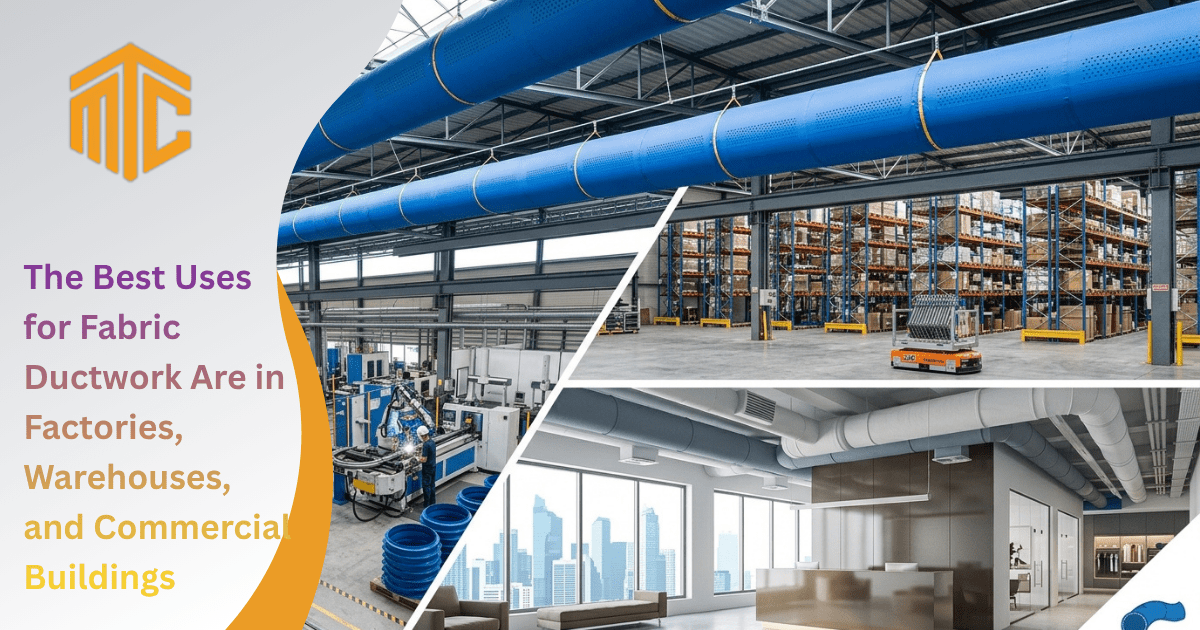
Fabric ductwork has become a practical air distribution option for large commercial and industrial spaces where conventional duct systems may not provide the most effective combination of airflow coverage, installation flexibility, and maintenance. Factories, warehouses, and commercial buildings often have large floor areas, high ceilings, changing occupancy patterns, and significant air conditioning requirements. In these environments, fabric air ducts can distribute conditioned air across wider areas while offering a lightweight alternative to conventional metal ductwork. From production facilities and logistics centers to retail spaces and commercial halls, the right fabric air distribution system can be designed around the building’s cooling requirements, layout, and occupancy.
Large buildings require more than simply moving air from an HVAC unit to an occupied area. The system must distribute conditioned air at suitable velocities and locations so that the entire space receives effective ventilation and cooling.
A fabric air duct can be engineered with different diameters, perforation patterns, nozzles, and air outlets according to the requirements of the project. This allows the system to distribute air along the length of the duct rather than relying exclusively on conventional point diffusers.
Even Air Distribution Across Large Areas
One of the main advantages of a fabric air distribution system is its ability to provide broad and controlled airflow. A circular fabric air duct can be designed to release air through permeable fabric, perforations, or engineered openings.
This makes fabric duct particularly useful where the goal is to achieve a duct for even air distribution across a large occupied area.
Lightweight Construction
Fabric ducts are considerably lighter than rigid metal ductwork. This can simplify transportation, lifting, suspension, and installation, particularly in facilities where ductwork must be installed at significant heights.
Flexible Installation
The suspension system can be designed around the building’s structure and HVAC layout. This provides flexibility when installing air distribution systems in open industrial or commercial spaces.
Fabric Ducts for Factories
Factories are among the most suitable applications for fabric ventilation ducts because production areas often have large open floors and high ceilings. Depending on the manufacturing process, the facility may require consistent cooling and ventilation across areas that cannot be effectively served by a small number of conventional outlets.
Why Fabric Air Ducts Suit Production Areas
Fabric air ducts can be designed to distribute conditioned air across production floors. The air outlet pattern can be calculated according to the required airflow, ceiling height, target zones, and desired air velocity.
For facilities with large machinery layouts, the duct design can also be adapted to provide air coverage around specific production areas.
Cooling Large Factory Floors
Industrial facilities in Saudi Arabia can experience substantial cooling demands. A properly engineered fabric air conditioning duct can distribute cooled air across large areas while reducing the concentration of airflow in limited locations.
This can be particularly useful when workers occupy different sections of a large production floor.
Fabric Duct Installation in Factories
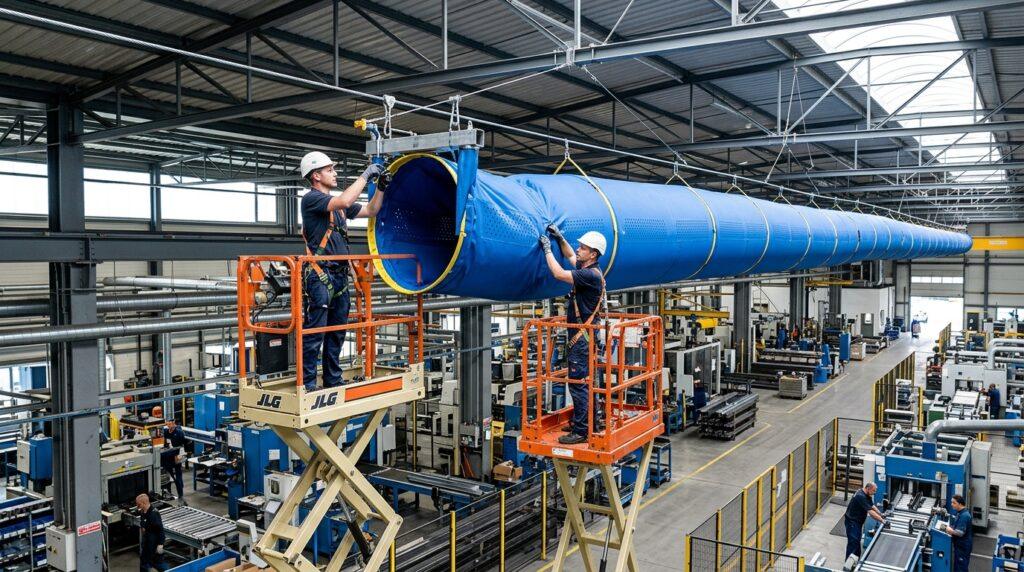
Fabric duct installation can be practical in factories because the material is lightweight and can be suspended above production areas without the same handling requirements associated with heavy rigid duct sections.
However, installation should still be based on accurate airflow calculations, duct sizing, suspension requirements, and the operating conditions of the facility.
When Fabric Duct Is a Good Factory Solution
Fabric ducts for factories are particularly suitable when the project requires:
- Broad conditioned-air coverage
- Even air distribution
- Lightweight overhead ductwork
- High-ceiling installation
- Flexible air outlet positioning
- Corrosion-resistant duct fabric
- Accessible cleaning and maintenance
Fabric Duct for Warehouses
Warehouses present a different air distribution challenge. Large storage areas, high ceilings, long aisles, and changing inventory layouts can make conventional air distribution difficult to optimize.
A fabric duct for warehouses can be designed to distribute conditioned air over a wide area while controlling air throw and velocity.
High-Ceiling Air Distribution
One of the most important considerations in a warehouse is ensuring that conditioned air reaches the occupied zone rather than remaining near the ceiling.
Fabric air ducts can use engineered openings and calculated air throw to direct airflow toward the required areas. The design can be adjusted according to the ceiling height and cooling requirements.
Cooling Storage and Logistics Areas
Warehouses used for logistics, distribution, retail storage, or industrial operations may require consistent temperatures across large areas.
A fabric air distribution system can provide a practical approach where the building requires broad airflow rather than a highly segmented duct network.
Canvas for Warehouses and Textile Duct Systems
Fabric-based duct systems are sometimes described using terms such as canvas for warehouses, cloth duct, textile air ducts, or duct fabric. The exact material should always be selected according to the HVAC requirements and manufacturer’s specifications rather than relying on the general term “canvas.”
Modern duct fabric can be engineered for specific airflow, durability, cleaning, and environmental requirements.
Warehouse Applications in Saudi Arabia
For Saudi warehouses, cooling performance is particularly important because external temperatures can place substantial demands on air conditioning systems. Proper duct sizing, airflow calculations, insulation, and air throw design remain essential regardless of the duct material.
Fabric duct can be especially useful when the warehouse has large open areas where uniform conditioned-air distribution is required.
Fabric Duct for Commercial Buildings
Commercial buildings have different requirements from factories and warehouses. Appearance, occupant comfort, maintenance, and integration with the interior design can all influence the choice of an air distribution system.
Duct fabric for commercial buildings can provide a combination of functional air distribution and customizable appearance.
Retail Spaces and Showrooms
Large retail stores and showrooms often have open ceilings or visible services. Fabric air ducts can be manufactured in different colors and configurations, allowing the ductwork to complement the interior environment.
At the same time, the system can be engineered to distribute conditioned air across customer and staff areas.
Offices and Commercial Halls
For large open-plan offices, halls, and similar spaces, fabric air distribution can provide broad airflow coverage. However, buildings with many enclosed offices and independently controlled rooms may require a more complex HVAC layout.
In such cases, fabric duct can be used selectively in open areas while other parts of the air conditioning system use conventional ductwork.
Hospitality and Public Spaces
Fabric ventilation ducts can also be considered for selected hospitality, recreational, and public areas where exposed ductwork is acceptable or desirable.
The final selection should consider the architectural requirements, cooling load, noise expectations, air velocity, cleaning requirements, and overall HVAC design.
Fabric Duct for Restaurants and Commercial Kitchens
Restaurants can benefit from fabric air distribution where conditioned-air delivery, appearance, and maintenance are important.
Fabric Duct for Restaurants
A fabric duct for restaurants can distribute conditioned air across dining areas without requiring numerous visible rigid diffusers. The duct can also be customized to suit the interior design.
However, supply-air distribution and kitchen exhaust are separate HVAC functions.
Duct Fabric for Commercial Kitchens
Duct fabric for commercial kitchens requires careful consideration because cooking areas can involve heat, grease, smoke, moisture, and specific fire-safety requirements.
Standard fabric supply-air systems should not be treated as a universal substitute for specialized kitchen exhaust ductwork. The exhaust system should be selected according to the project’s applicable requirements.
Why Fabric Duct Is Suitable for These Applications
The suitability of fabric ductwork for factories, warehouses, and commercial buildings comes from several characteristics that align with the requirements of large spaces.
Designed for Distributed Airflow
Unlike systems that rely mainly on point outlets, a fabric air duct can be designed to distribute air over a substantial length.
Lightweight Compared With Metal Ductwork
The lower weight can make handling and installation easier, especially in large facilities.
Customizable Air Distribution
Perforations, nozzles, and other outlet patterns can be designed according to the required airflow and air throw.
Suitable for Visible Installations
Fabric ducts can be manufactured in different colors and configurations, making them useful where exposed ductwork is part of the building design.
Washable Construction
Depending on the fabric specification, sections can be removed and cleaned, supporting routine fabric duct maintenance.
Corrosion Resistance
Selected textile materials can provide resistance to corrosion, which can be beneficial in environments where conventional metal ductwork may require additional protection.
Fabric Duct Installation for Industrial and Commercial Projects
Professional fabric duct installation begins before the duct reaches the site. The HVAC design should establish airflow requirements, duct diameter, pressure, air throw, suspension, and outlet configuration.
Airflow and Duct Sizing
The fabric air duct must be sized according to the required airflow. Oversized or undersized ductwork can affect air velocity and distribution.
Suspension and Support
Fabric ducts can be installed using cables, tracks, or other suspension systems. The selected system depends on the duct design, building structure, length, and installation environment.
Final Air Distribution
After installation, the system should be checked to confirm that airflow reaches the intended areas and that the duct maintains the designed shape and position.
This is why installation of fabric air ducts should be handled by an experienced HVAC or air distribution systems contractor rather than treated as a basic installation task.
Fabric Duct Manufacturing for Different Applications
Fabric duct manufacturing should be tailored to the requirements of the building rather than using one standard design for every project.
For a factory, the design may prioritize high-volume cooling and broad floor coverage. A warehouse may require specific air throw to reach occupied areas beneath a high ceiling. A commercial building may place greater emphasis on appearance, comfort, and integration with the interior.
The fabric specification, diameter, seams, suspension method, perforation pattern, and connections should therefore be selected according to the project’s HVAC requirements.
Fabric Duct Maintenance and Cleaning
Regular maintenance helps preserve airflow performance and the condition of the duct system.
Cleaning the Fabric Duct
One of the practical benefits of textile air ducts is that many systems can be removed from their suspension and washed according to the manufacturer’s recommendations.
Cleaning frequency depends on the facility. Factories and warehouses with high dust levels may require more frequent inspection and cleaning than cleaner commercial environments.
Cleaning the FabRoutine Fabric Duct Maintenance ric Duct
Fabric duct maintenance can include checking:
- Fabric condition
- Seams and connections
- Suspension systems
- Air openings and perforations
- Duct alignment
- Signs of damage or wear
A planned maintenance schedule can help identify problems before they affect air distribution.
How to Choose a Fabric Duct Contractor in Saudi Arabia
Choosing the right Duct fabric contractor is important for large commercial and industrial projects. Fabric ductwork should be engineered, manufactured, supplied, and installed according to the HVAC design.
An experienced Duct Fabric Company should understand airflow calculations, fabric selection, air throw, suspension, installation conditions, and maintenance requirements.
For projects requiring Supply and installation of fabric ducts, the contractor should also be able to coordinate the fabric system with the existing air handling equipment and broader HVAC infrastructure.
Choosing the right Duct fabric contractor is important for large commercial and industrial projects. Fabric ductwork should be engineered, manufactured, supplied, and installed according to the HVAC design.
An experienced Duct Fabric Company should understand airflow calculations, fabric selection, air throw, suspension, installation conditions, and maintenance requirements.
For projects requiring Supply and installation of fabric ducts, the contractor should also be able to coordinate the fabric system with the existing air handling equipment and broader HVAC infrastructure.
Are Fabric Ducts the Best Choice for Every Building?
Fabric ductwork is highly suitable for many large open spaces, but it is not automatically the best solution for every building.
It is particularly effective where the project needs:
- Large-area air distribution
- Even cooling coverage
- Lightweight ductwork
- High-ceiling air delivery
- Flexible air outlet design
- Easy cleaning
- Visible and customizable ductwork
Metal ductwork may remain more suitable for highly segmented buildings, rigid duct routes, demanding pressure conditions, specialized exhaust, or applications requiring specific structural characteristics.
The best duct for air distribution should therefore be selected according to the building, HVAC design, operating conditions, and project requirements.
Conclusion
Fabric ductwork is particularly well suited to factories, warehouses, and commercial buildings where large areas require consistent conditioned-air distribution, flexible installation, and practical maintenance. With proper engineering, fabric air ducts can provide effective cooling coverage while offering a lightweight and customizable alternative to conventional ductwork. Multi Tech provides fabric duct and HVAC solutions in Saudi Arabia, supporting commercial and industrial projects with application-specific air distribution systems.
Frequently Asked Questions
Where are fabric ducts most commonly used?
Fabric ducts are commonly used in factories, warehouses, sports halls, retail spaces, commercial buildings, restaurants, and other large areas where broad and even air distribution is required.
Are fabric ducts suitable for warehouses?
Yes. Fabric ducts for warehouses can be designed for high ceilings and large open areas, using calculated air throw and outlet patterns to distribute conditioned air toward the required zones.
Can fabric duct be used in factories?
Yes. Fabric ducts for factories can provide broad cooling and ventilation coverage across production floors while offering lightweight construction and customizable airflow patterns.
Is fabric duct suitable for commercial buildings?
Yes. Duct fabric for commercial buildings can be suitable for retail spaces, showrooms, halls, and other open commercial areas where even air distribution and exposed ductwork are desired.