
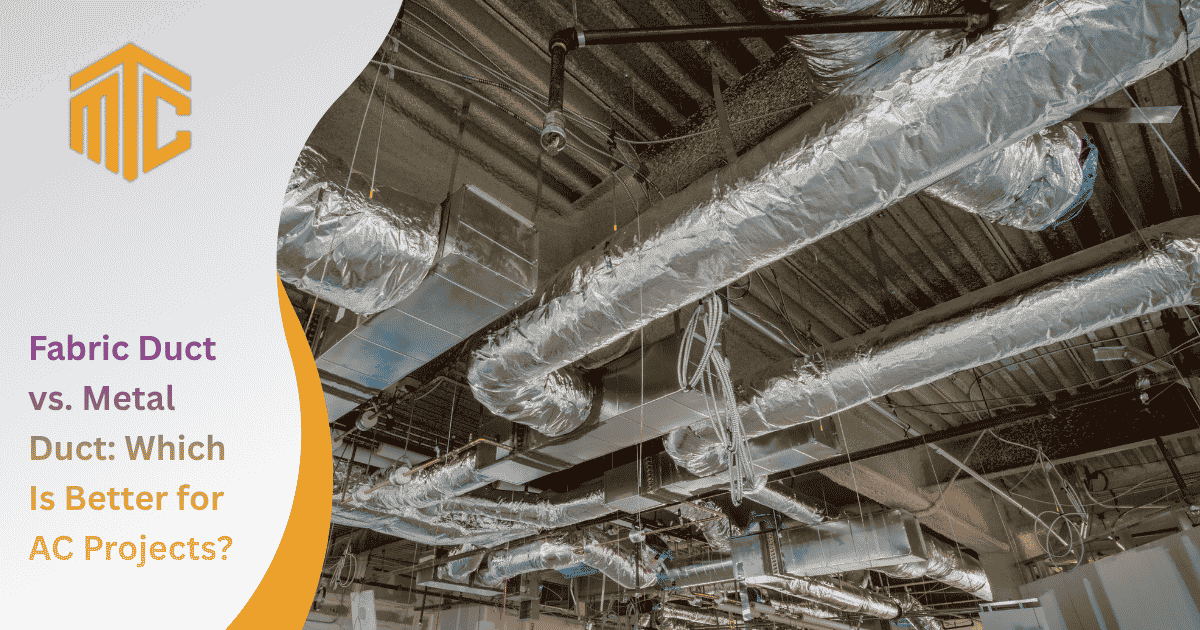
Choosing the right duct system is an important part of designing an effective air conditioning system. Fabric air ducts and metal ductwork can both distribute conditioned air, but they differ in how they handle cooling airflow, air throw, installation, maintenance, and project costs. Fabric ductwork is increasingly used as an alternative to metal ductwork in large air-conditioned spaces such as factories, warehouses, sports halls, restaurants, and commercial buildings because it can distribute cooling air over a wide area. Metal ducts remain widely used where rigid construction, complex air-conditioning layouts, higher pressure, or specialized requirements are involved. For HVAC projects in Saudi Arabia, the better option depends on the cooling requirements, space configuration, airflow design, operating conditions, and long-term maintenance needs.
The difference between fabric and metal ductwork becomes particularly important when the duct system is being used to distribute cooled air throughout a building.
Fabric Air Conditioning Duct
A fabric air conditioning duct uses engineered textile material to transport and distribute conditioned air. It may also be described as a cloth duct, fabric air duct, textile air duct, or fabric ventilation duct. A circular fabric air duct is commonly used because its shape allows the duct to operate effectively under internal air pressure. Air can be delivered through the fabric itself, perforations, or engineered openings, depending on the required cooling pattern.
Metal Air Conditioning Duct
Metal ductwork uses rigid sections to transport conditioned air from an air handling unit or other HVAC equipment to diffusers, grilles, or registers. It can be configured with branches, dampers, transitions, and multiple outlets to serve different rooms or zones. The main difference is therefore how the conditioned air is delivered. Fabric systems can distribute cooling air along the duct length, while metal systems generally transport air to selected terminal outlets.
For an air conditioning project, moving air is only part of the requirement. The system must distribute cooled air effectively across the occupied space.
Fabric Duct for Even Cooling Air Distribution
One of the main advantages of a fabric air distribution system is its ability to distribute conditioned air over a wider section of the duct. A properly designed system can use permeable duct fabric, perforations, or nozzles to control air velocity and direction.
This makes fabric duct a strong duct for even air distribution in large air-conditioned areas. Instead of concentrating cooling air at a limited number of outlets, the system can be designed to provide more distributed coverage.
For large production floors, warehouses, and sports facilities, this approach can help address areas where conventional outlet arrangements may make uniform cooling more difficult.
Metal Duct for Zoned Cooling
Metal ductwork provides strong control when an air conditioning system needs to serve several rooms or independently controlled zones. Dampers, diffusers, and branches can be positioned according to the HVAC design.
This can make metal ductwork more practical for offices, hotels, hospitals, and commercial buildings with many separate occupied spaces.
For large open cooling areas, fabric duct often has an advantage in uniform air distribution. For highly zoned air conditioning systems, metal ductwork can provide greater control.
Air Throw and Cooling Coverage
Air throw is an important consideration when distributing conditioned air, particularly in buildings with high ceilings.
Fabric Duct Air Throw
A fabric air distribution system can be engineered with different perforation sizes, opening patterns, and outlet arrangements to achieve the required air throw. This allows the cooling airflow to be directed toward specific areas rather than simply released at random points.
For high-ceiling warehouses and industrial facilities, correct throw design is essential to ensure that cooled air reaches the required occupied zone.
Metal Duct Air Throw
Metal duct systems normally rely on diffusers, grilles, and registers to determine air throw. These components can provide precise discharge characteristics and can be selected according to the room’s cooling requirements.
The better option depends on the building. Fabric duct can provide flexible distribution across large areas, while metal duct offers precise control through individual air outlets.
Static Pressure and Air Conditioning Performance
Static pressure is an important part of HVAC duct design. Incorrect pressure calculations can affect airflow, fan performance, and overall air conditioning efficiency.
Fabric Duct Pressure Requirements
A fabric duct system must be designed according to the operating pressure of the air conditioning equipment and the specifications of the selected duct fabric. The duct diameter, length, openings, and suspension system all contribute to the final system design.
A qualified fabric duct manufacturer or contractor should therefore perform the necessary airflow and pressure calculations before production.
Metal Duct Pressure Performance
Rigid metal ductwork can accommodate a broad range of HVAC applications and is commonly selected where higher pressure or rigid construction is required.
For standard conditioned-air distribution within the specified operating range, fabric duct can perform effectively. For demanding pressure conditions, metal ductwork may provide the stronger solution.
Fabric Duct Installation
Fabric duct installation uses lightweight textile sections that can be suspended from cables, tracks, or other support systems. The reduced weight can make transportation, handling, lifting, and positioning easier.
Installation of fabric air ducts still requires professional planning. The duct diameter, suspension points, connections, air openings, and final positioning must correspond with the HVAC design.
Metal Duct Installation
Metal duct installation generally involves transporting and lifting rigid sections, connecting them, sealing joints, installing supports, and adding insulation where required.
Large metal air conditioning systems can require substantial structural support and coordination with other services installed above ceilings or at high levels.
For large air-conditioned facilities where installation weight and handling are important considerations, fabric duct can offer a practical advantage.
More Distributed Cooling
A fabric air distribution system can deliver cooled air over a larger area, helping reduce reliance on concentrated air outlets.
Lightweight Construction
Fabric duct is significantly lighter than conventional metal ductwork, which can simplify installation and support requirements.
Corrosion Resistance
Depending on the selected material, duct fabric can provide good resistance to corrosion-related problems that may affect metal duct systems in certain environments.
Flexible Air Distribution
Perforations and engineered openings can be designed according to the required cooling pattern, allowing the system to be adapted to the space.
Washable Construction
Many textile air ducts can be removed and washed according to the manufacturer’s maintenance instructions, supporting regular cleaning.
Disadvantages of Fabric Ducting for Air Conditioning
Limited Pressure and Temperature Applications
Fabric systems must remain within their specified pressure and temperature limits. They should not automatically be selected for demanding HVAC or exhaust applications.
Requires Accurate Design
The cooling performance of fabric duct depends on proper airflow calculations, sizing, opening design, and air throw. Poor design can lead to inadequate coverage or uncomfortable air velocities.
Less Suitable for Complex Networks
Air conditioning systems with many branches, transitions, dampers, and independently controlled rooms may be easier to configure using rigid metal ductwork.
Textile Maintenance
Although fabric sections can often be washed, they require an appropriate cleaning schedule and handling process.
Cost of Fabric Duct vs. Metal Duct
Fabric Duct Cost
Fabric duct cost can depend on duct size, length, fabric type, airflow requirements, perforation design, suspension system, connections, and installation.
Its low weight may reduce some handling and structural-support requirements, which can affect the overall installed cost.
Metal Duct Cost
Metal duct costs include material, fabrication, fittings, supports, insulation, sealing, transportation, and labor. Complex air conditioning layouts can increase the number of components and installation requirements.
The more cost-effective system depends on the project. A complete comparison should include material, installation, support, maintenance, and long-term requirements.
Cleaning and Fabric Duct Maintenance
The maintenance strategy should be considered when designing an air conditioning system.
Cleaning the Fabric Duct
Cleaning the fabric duct generally involves removing textile sections from their suspension system and washing them according to the manufacturer’s recommendations.
This can be useful in facilities where maintaining clean conditioned-air distribution is important.
Fabric Duct Maintenance
Fabric duct maintenance includes checking the fabric, seams, suspension system, connections, and air openings. Cleaning frequency depends on the facility and the amount of dust or contamination present.
Metal duct systems also require inspection and cleaning, but internal access can sometimes make the process more complex.
For projects where regular removal and washing are beneficial, fabric duct can offer a maintenance advantage.
Saudi Arabia has extensive demand for reliable cooling across commercial, industrial, logistics, retail, hospitality, and public facilities. However, the hot climate does not automatically make one duct material better than the other.
Fabric Ducts for Factories
Fabric ducts for factories can distribute conditioned air across large production areas and can be useful where broad cooling coverage is required.
Canvas for Warehouses
For warehouses, fabric-based air distribution can help deliver conditioned air across high-ceiling and open storage areas. The system can be engineered according to the required cooling coverage.
Fabric Duct for Sports Halls
Fabric duct for sports halls can provide distributed cooling airflow across large occupied areas while allowing the ductwork to remain visible as part of the interior design.
Fabric Duct for Restaurants
Fabric duct for restaurants can be considered for conditioned-air distribution where appearance, comfort, and cleanability are important.
Duct Fabric for Commercial Buildings
Duct fabric for commercial buildings can be suitable for large open retail spaces, showrooms, halls, and other air-conditioned environments requiring broad air distribution.
Duct Fabric for Commercial Kitchens
Duct fabric for commercial kitchens needs careful application-specific consideration. Standard fabric supply-air systems should not be treated as a replacement for specialized kitchen exhaust systems where heat, grease, smoke, and fire requirements apply.
Fabric Ductwork as an Alternative to Metal Ductwork
Fabric ductwork can be an effective alternative to metal ductwork when an air conditioning project prioritizes even cooling distribution, lightweight installation, corrosion resistance, and easy cleaning.
However, it is not a universal replacement. Metal ductwork can remain the better option for complex air conditioning networks, higher-pressure requirements, rigid pathways, and specialized applications.
In some projects, both systems can be used together. Metal ductwork can provide the main rigid air route, while a fabric air distribution system can be used in selected large spaces to deliver conditioned air more evenly.
Fabric Duct Manufacturing and Installation
Quality fabric duct manufacturing is important because the finished system must match the air conditioning design. Fabric type, dimensions, seams, connections, suspension, and air openings all need to be considered.
Professional fabric duct installation should follow the approved airflow and layout calculations. Incorrect positioning or suspension can affect the intended cooling distribution.
A qualified Duct fabric contractor can coordinate design, manufacturing, supply, and installation rather than treating the textile duct as a standard off-the-shelf product.
The contractor’s experience is particularly important for commercial and industrial air conditioning projects. An experienced Air distribution systems contractor should evaluate the building size, cooling load, airflow requirements, duct dimensions, pressure, air throw, installation height, and maintenance requirements.
Multi Tech provides customized fabric duct solutions in KSA for commercial, industrial, and residential applications, with services covering design, supply, installation, and post-installation support. Multi Tech also provides broader HVAC services for projects across Saudi Arabia.
For clients looking for an Air Distribution Systems Company, choosing a provider capable of handling both engineering and installation can help ensure that the selected duct system works correctly with the overall air conditioning design.
Fabric Duct vs. Metal Duct: Which Is Better?
The best duct for air distribution depends on the air conditioning project’s priorities.
Fabric Duct Is Better When:
- The space is large and open.
- Even cooling distribution is important.
- Lightweight installation is beneficial.
- The ductwork will remain visible.
- Corrosion resistance is required.
- Washable duct sections are useful.
- Flexible air distribution is needed.
Metal Duct Is Better When:
- The system requires rigid construction.
- Multiple rooms or zones need individual outlets.
- The HVAC system has a complex network.
- Higher pressure conditions are involved.
- Specialized exhaust is required.
- Specific project requirements favor rigid ductwork.
Fabric Duct vs. Metal Duct: Direct Comparison
AC Factor | Fabric Duct | Metal Duct |
Cooling distribution | Broad and even when properly designed | Controlled through diffusers and outlets |
Air throw | Designed through fabric openings and nozzles | Controlled through diffusers and grilles |
Large open spaces | Excellent | Good with suitable outlet design |
Installation | Lightweight and easier to handle | Heavier and more labor-intensive |
Static pressure | Suitable within specified limits | Strong option for demanding pressure |
Maintenance | Removable and washable sections | Cleaning may require greater access |
Corrosion | Good resistance depending on fabric | May require protection |
Complex HVAC layouts | Less suitable | Highly suitable |
Appearance | Customizable | Rigid conventional appearance |
Cost | Competitive depending on installation | Varies with fabrication and installation |
Specialized applications | Limited by material specifications | Broad application range |
Conclusion
For air conditioning projects, fabric duct is often the better choice for large spaces requiring even cooling distribution, lightweight installation, and easy maintenance, while metal duct is more suitable for rigid, complex, and demanding HVAC systems. The right selection depends on cooling requirements, airflow, pressure, installation, cost, and maintenance. Multi Tech provides customized fabric duct solutions in Saudi Arabia for commercial and industrial air conditioning projects.
Frequently Asked Questions
Is fabric duct better than metal duct for air conditioning?
Fabric duct is often better for large open air-conditioned spaces requiring even cooling distribution, while metal duct is generally more suitable for complex and high-pressure HVAC systems.
Which duct is better for cooling warehouses and factories?
Fabric duct is often suitable for warehouses and factories because it can distribute conditioned air across large open areas and high ceilings.
Is fabric duct cheaper than metal duct?
The total cost depends on the project design, installation, support requirements, and maintenance. Fabric duct can be cost-effective where its lightweight construction reduces installation requirements.
Can fabric duct replace metal ductwork in an HVAC system?
Yes, fabric ductwork can replace metal ductwork in many suitable supply-air applications, but metal remains preferable for certain high-pressure, complex, and specialized HVAC requirements.