

Fabric duct distributes conditioned supply air through an engineered textile system. Depending on the selected design, air leaves through permeable fabric, purpose-made openings or a combination of both. Its performance depends on the airflow arrangement and installation conditions, rather than the textile material alone.
For facility engineers and project specifiers in Saudi Arabia, the practical questions are how the system will serve the occupied space, whether the selected product suits the environment and how it will be accessed for care. This guide explains those decisions without assuming every fabric duct has the same properties or cleaning requirements.
What Is A Fabric Duct?
A fabric duct is a textile component used to distribute air within a space. It connects to the supply-air system and is supported by a specified suspension arrangement. The material, shape, outlet pattern and support details form part of the system selection. A drawing that shows only a coloured tube does not establish its performance.
Many installations use exposed fabric ducts in open interiors. The visible arrangement can make the air distribution layout easy to identify, but appearance is only one design consideration. Ask which product and fabric have been specified, what operating conditions the design assumes and which documentation supports that selection.
The duct distributes air supplied by the HVAC equipment; it does not independently produce cooling. Understanding that boundary helps avoid diagnosing every comfort complaint as a fabric problem. The system review should include supply conditions, controls, the room load and the air distribution arrangement. See the HVAC service scope for wider system coordination.
How Fabric Duct Distributes Air
Air Through Permeable Fabric
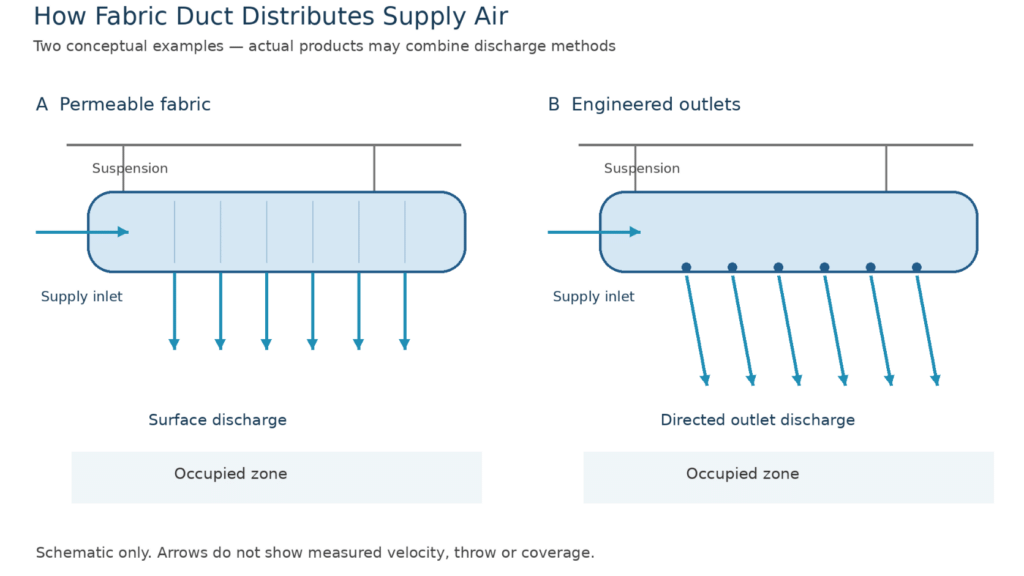
In a permeable design, air can pass through the textile surface. Manufacturer guidance describes fabric weave and internal static pressure as factors governing that discharge. Static pressure means the pressure available within the duct to drive air through its intended outlets. It is a design input that must be checked for the selected product.
Porous fabric can also be combined with engineered outlets. Therefore, “fabric duct” does not identify a single discharge pattern. Request a drawing that distinguishes surface discharge from outlet discharge and explains how the proposed arrangement serves the room. Avoid assuming that every square metre of textile releases the same amount of air.
Air Through Engineered Openings And Nozzles
Other arrangements release air through designed openings, vents or nozzles. Their layout and orientation help determine where air is directed. Throw describes the distance a supply jet travels under specified conditions; the required throw must be assessed against mounting height and the location of people or equipment.
An annotated concept diagram below separates these mechanisms for clarity. Actual products may combine them. Its arrows show the intended discharge path only; their length does not represent measured velocity or coverage. The final outlet arrangement belongs in the manufacturer’s design submission and the HVAC review.
Ask the designer how performance changes across the intended operating range. A layout selected for one supply condition should not be assumed to behave identically after fan settings, temperature conditions or room use change. Keep the agreed design inputs with the handover records so later investigations have a reliable starting point.
Where Fabric Duct Can Be Considered
Fabric duct manufacturers offer systems for warehouse, production, sports and commercial applications. These categories are starting points for evaluation rather than automatic approvals. Two rooms with the same use can have different ceiling heights, obstructions, hygiene requirements and environmental conditions. See manufacturer design guidance for product-specific context.
In a warehouse, review the relationship between the air distribution layout, storage racks and occupied work areas. Give the designer the rack arrangement and any planned layout changes. A clear roof-level route does not establish that air will reach the required working zones without an application-specific assessment.
For sports halls and commercial interiors, discuss comfort expectations, mounting position and architectural coordination. Ask how the proposed distribution arrangement addresses occupied areas and any restrictions on visible services. Avoid promising a draft-free result simply because the duct is made from fabric.
In production or hygiene-sensitive spaces, establish the process conditions and the facility’s cleaning requirements before selecting material. A washable textile alone does not demonstrate suitability for every controlled environment. Require the relevant product documentation and review the arrangement with the facility’s responsible technical and hygiene teams.
MTC’s Fabric Duct page lists commercial, industrial and sports applications. Confirm its proposed product, delivery scope and application suitability for your project rather than treating that list as approval for every condition within those sectors.

Selection Limits To Check Before Specification
A practical selection review should connect the room requirements to evidence from the proposed manufacturer. Record assumptions, missing inputs and any restrictions on use. Where a product rating or maintenance instruction is unavailable, obtain it before approving a material substitution.
| What to check | Why it matters | Evidence to request |
|---|---|---|
| Airflow and pressure | Confirm the operating range | Design inputs and product limits |
| Height and throw | Match discharge to occupied zones | Layout and performance selection |
| Obstructions and layout | Check racks, partitions and services | Coordinated room drawing |
| Material and environment | Verify exact textile suitability | Product data and rating evidence |
| Access and care | Plan removal and reinstatement | Suspension and care instructions |
Check condensation claims carefully. Ask the manufacturer to assess the proposed system against the actual environmental and operating conditions. Do not generalise a product-specific statement into a guarantee that every fabric duct remains dry. The same principle applies to acoustic claims, antimicrobial treatments and anticipated service life.
Material fire performance also requires precise documentation. Request evidence for the exact textile and configuration, then have the responsible professional confirm its relevance to the applicable project requirements. A marketing description such as “flame retardant” should not replace the necessary technical review or be presented as a fire-resistance rating.
Treat comfort supply air and specialist exhaust as separate selection questions. A fabric supply-air application in a restaurant does not establish suitability for grease exhaust, smoke extraction or another hazardous duty. Refer those duties to the responsible engineer and the exact manufacturer documentation before considering a product for them.
If a fabric-versus-metal comparison is needed, assess both engineered proposals against the same requirements. Air distribution, noise, cleaning access and cost depend on the complete design and installation. Remove assumptions that conventional metal ductwork inherently performs poorly or that fabric always offers lower project cost. Read the separate fabric duct versus metal duct comparison for the detailed selection discussion.
Maintenance Must Follow The Selected Manufacturer
Start the maintenance record with the manufacturer, product identification, fabric designation and the current care instructions. Record the section arrangement and suspension system so the team can identify what may be removed and how it must be reinstated. Retain these details when the operating team changes.
Manufacturer care guidance distinguishes performance, appearance and hygiene considerations. These can lead to different cleaning decisions. For example, a facility may require cleaning for hygiene or presentation even where there is no confirmed airflow complaint. Conversely, a comfort complaint needs investigation rather than an automatic assumption that laundering is the solution. See manufacturer care guidance for product-specific context.
Confirm The Cleaning Method And Trigger
Use the instructions for the installed product to establish approved cleaning methods, any laundering restrictions and the inspection or condition triggers. Ask for clarification where a fabric treatment or accessory changes those instructions. Do not copy a washing temperature, detergent or interval from another manufacturer or fabric grade.
Consider filtration and contamination sources when setting the care plan. Manufacturer guidance identifies these among the factors affecting cleaning needs. The plan should also reflect the facility’s own hygiene requirements. A universal monthly, annual or multi-year interval is not appropriate without confirmation for the actual installation.
Plan Access And Reinstallation
Coordinate access, the necessary system shutdown and the effect on occupied areas before removal. Removable sections do not prove that the rest of the system can operate normally while a section is absent. The operating arrangement during maintenance must be agreed through the site’s authorised process and the manufacturer’s instructions.
Follow the selected care instructions for drying, handling and reinstallation. Check section orientation, suspension and connections against the installation documents. Record visible damage or missing identification and refer uncertain repairs to the manufacturer. Do not improvise holes, outlets or fabric repairs that could alter the specified distribution arrangement.
After reinstatement, arrange the operational checks required by the responsible team and record anything that differs from the accepted condition. Where room use or the HVAC operating conditions have changed, request a design review rather than treating the original layout as automatically suitable. Coordinate any required checks with the building commissioning team where included in its appointment.
Information To Share With MTC
Prepare the room dimensions, ceiling and mounting heights, intended use, layout, available HVAC information and any environmental or hygiene constraints. Include service access limitations and the expected operating pattern. Ask MTC to identify the proposed product, design inputs, material evidence, suspension arrangement and manufacturer care documents in its response.
Review MTC’s Fabric Duct service page to discuss the proposed scope. Keep final design and operating requirements subject to the appointed HVAC reviewer’s confirmation.
Frequently Asked Questions
Does Every Fabric Duct Release Air Through Its Surface?
No. Fabric systems can distribute air through permeable material, engineered outlets or a combination. The product designation and design drawings should identify the actual arrangement. Ask the supplier to explain which discharge paths are included and how their selection relates to the room requirements before approving the layout.
Can Fabric Duct Remain Open When The Fan Stops?
That depends on the selected product and support arrangement. Do not infer the fan-off shape from a photograph of an operating system. Ask the supplier for the suspension and shape-retention details, including how those accessories affect installation, access and removal. Confirm that the proposed arrangement matches the architectural requirements.
How Often Should Fabric Duct Be Cleaned?
Use the installed product’s manufacturer guidance together with the facility’s hygiene and inspection requirements. Filtration, contamination and appearance can influence the cleaning decision. Avoid adopting a general interval from another project. Record the agreed trigger or schedule and retain the applicable care instructions with the system’s operating documents.
Can Fabric Duct Be Used For Kitchen Grease Exhaust?
A comfort supply-air installation in a kitchen does not demonstrate suitability for grease exhaust. Treat extraction as a separate duty requiring assessment by the responsible engineer and evidence for the proposed product and application. Do not substitute ordinary textile supply ductwork based only on washability or a general restaurant application claim.
What Should Be Checked When A Room Layout Changes?
Share the revised layout, obstructions and occupancy requirements with the responsible HVAC designer. Check whether the existing discharge arrangement and operating conditions still serve the intended zones. Keep the updated assessment and drawings with the operating records. Moving storage or partitions should not be treated as unrelated to air distribution performance.