
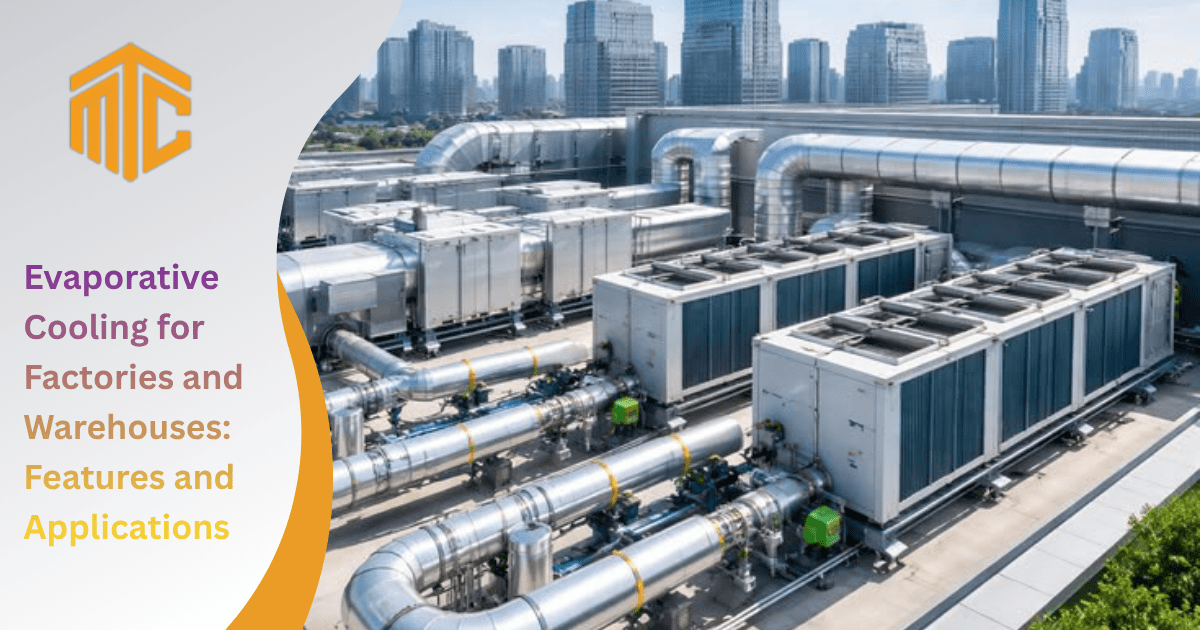
Factories and warehouses in Saudi Arabia often face extreme summer temperatures, large open areas, high ceilings, heat-generating equipment, and frequent movement of people and goods. Cooling these spaces with conventional air conditioning can require significant energy and infrastructure. Evaporative cooling for factories and warehouses offers an alternative by using water evaporation to reduce air temperature while delivering large volumes of fresh, cooled air. Also known as a desert cooler, air cooler, or evaporative air conditioner, this technology can be particularly effective in hot and relatively dry environments where high airflow and energy-efficient cooling are important.
Evaporative cooling is a natural cooling process that uses water evaporation to reduce the temperature of incoming air. An industrial evaporative cooler draws warm outdoor air through wet cooling pads. As water evaporates, it absorbs heat from the air, resulting in cooler air that is then supplied into the factory or warehouse.
Unlike traditional air conditioning, an evaporative cooling system does not rely on a conventional refrigeration cycle for direct evaporative cooling. Instead, it uses a fan, water pump, cooling pads, and air distribution system to provide cooling.
This approach is particularly relevant to industrial facilities where the objective is often to improve working conditions across a large area rather than maintain a tightly controlled temperature in every part of the building.
Why Do Factories and Warehouses Need Specialized Cooling?
Industrial buildings are different from offices, retail stores, and residential spaces. Their cooling requirements can be affected by several factors.
Factories may contain machinery, furnaces, motors, production lines, lighting, and other equipment that generates considerable heat. Warehouses may have large loading doors that remain open, high ceilings, extensive floor areas, and frequent movement of goods.
These characteristics make conventional cooling challenging and potentially expensive.
An industrial air cooler can provide high-volume airflow across large areas, helping move heat away from occupied zones while introducing cooler outdoor air.
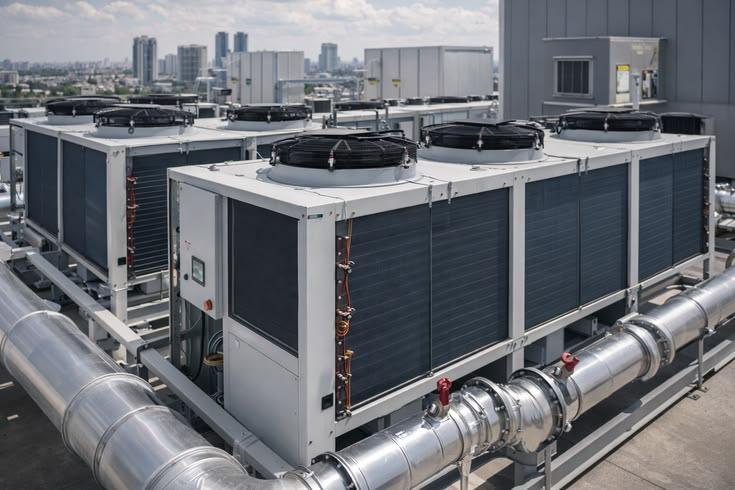
Key Features of Industrial Evaporative Coolers
High-Volume Airflow
One of the main features of an industrial evaporative cooler is its ability to deliver substantial airflow. Instead of focusing only on cooling a small enclosed room, industrial systems are designed to move air throughout large spaces.
This makes them suitable for production floors, storage facilities, workshops, loading areas, and large halls.
Energy-Efficient Cooling
A major reason businesses consider evaporative cooling is its potentially lower electricity consumption compared with conventional refrigeration-based air conditioning.
A direct evaporative cooler primarily uses electrical power for its fan, blower, water pump, and controls rather than a refrigeration compressor. This can make it an attractive option for facilities operating cooling equipment for long periods.
Actual energy consumption depends on equipment capacity, operating hours, airflow requirements, and system configuration.
Continuous Fresh-Air Supply
An evaporative air cooler can draw outdoor air into the facility and provide a continuous supply of cooled air.
This characteristic can be valuable in factories and warehouses where ventilation is important. It can also be beneficial in facilities with large doors, openings, or areas where indoor air needs to be regularly replaced.
Suitable for Large Open Areas
Large industrial spaces can be difficult and expensive to cool using conventional air conditioning.
A commercial evaporative cooler or industrial desert cooler can be considered for large production areas, warehouses, workshops, and other spaces where complete refrigeration-based air conditioning may not be necessary.
Flexible Air Distribution
Evaporative cooling can be designed for direct air discharge or connected to a ducted evaporative cooling system.
Ducted systems can distribute cooled air to specific areas, production zones, workstations, or sections of a warehouse. Proper duct sizing and airflow calculations are important to achieve consistent cooling.
Simple Cooling Principle
The basic principle behind an evaporative cooler is straightforward. Warm air passes through water-saturated cooling pads, water evaporates, and heat is absorbed from the air during the evaporation process.
This makes evaporative cooling fundamentally different from a traditional air conditioner that uses refrigerant and mechanical refrigeration.
Applications of Evaporative Cooling in Factories
Manufacturing Plants
Manufacturing facilities often experience significant internal heat from machinery and production processes. Evaporative cooling for factories can provide high-volume airflow across production floors while helping improve thermal comfort for employees.
It can be particularly useful where the building has high ceilings and large areas that do not require precise temperature control.
Textile Factories
Textile production environments can have specific ventilation and temperature requirements. An evaporative cooling system can provide continuous air movement while helping reduce heat in suitable climate conditions.
The system should be designed according to the facility’s humidity requirements because evaporative cooling adds moisture to the air.
Automotive Workshops
Automotive workshops can become extremely hot because of outdoor temperatures, vehicle engines, equipment, and large open doors. A commercial desert cooler can provide airflow and cooling without requiring the entire workshop to operate like a fully conditioned indoor room.
Metal and Fabrication Facilities
Welding, cutting, fabrication, and machinery can create substantial heat. Industrial evaporative cooling can help improve conditions around working areas where high airflow is required.
Production and Assembly Areas
Assembly facilities often have large floor areas and multiple workstations. Properly positioned evaporative coolers can supply cooled air across these areas and support a more comfortable working environment.
Applications of Evaporative Cooling in Warehouses
General Storage Warehouses
Warehouses often have large floor areas and high ceilings. Cooling the entire volume using traditional air conditioning can be costly.
An evaporative cooler for warehouses can provide high-volume cooled airflow where environmental requirements allow evaporative cooling.
Distribution Centers
Distribution centers may have loading bays that remain open for extended periods. This makes maintaining conventional conditioned air difficult.
Evaporative cooling can continuously introduce cooler outdoor air into the facility, helping reduce heat in occupied areas.
Logistics and Loading Areas
Loading and unloading zones can experience high heat exposure because of open doors and vehicle movement. Industrial air coolers can provide localized cooling to workers operating in these areas.
Agricultural Storage
Suitable agricultural storage facilities can also use evaporative cooling where temperature and humidity requirements allow it. The system should be selected based on the products being stored and their environmental requirements.
Evaporative Cooling for Large Halls and Open Spaces
The applications of evaporative cooling are not limited to factories and warehouses.
It can also be considered for:
- Commercial workshops
- Large halls
- Agricultural facilities
- Farm buildings
- Suitable barns
- Manufacturing plants
- Storage facilities
- Exhibition spaces
- Semi-open commercial areas
- Industrial workspaces
The common characteristic is that these facilities often require large volumes of moving air rather than precise room-by-room temperature control.
Ducted Evaporative Cooling for Factories and Warehouses
A ducted evaporative cooling system can be useful when cooled air needs to be distributed across multiple areas.
Instead of releasing cooled air from a single unit, ductwork can direct airflow toward specific zones. This can help businesses address areas with higher heat loads or greater occupancy.
Common solutions in this category include:
- Evaporative duct cooler
- Duct air cooler
- Central evaporative air conditioning
- Central evaporative cooling system
- Central desert cooler
- Ducted evaporative cooling system
- Evaporative cooling for buildings
The ductwork should be designed according to airflow requirements, pressure losses, building layout, and required air distribution.
How Does an Evaporative Cooler Perform in Saudi Arabia?
Saudi Arabia’s climate makes evaporative cooling particularly relevant in hot and relatively dry areas. When outdoor air has low enough humidity, water evaporation can produce a significant reduction in air temperature.
However, evaporative cooling performance depends on humidity. As humidity rises, the air has less capacity to absorb additional moisture, reducing the cooling effect.
For this reason, businesses should not select an evaporative cooler based only on outdoor temperature. A proper assessment should consider temperature, relative humidity, airflow, heat load, building openings, and the required indoor conditions.
Evaporative Cooler vs. Traditional Air Conditioning for Industrial Buildings
Both technologies have different strengths.
An evaporative cooler is often considered when a facility needs:
- High-volume airflow
- Fresh outdoor air
- Lower electricity consumption
- Cooling for large open spaces
- Cooling in hot and relatively dry conditions
- A practical solution for semi-open areas
Traditional air conditioning may be more appropriate when a facility requires:
- Precise temperature control
- Humidity removal
- Fully enclosed space conditioning
- Consistent indoor environmental conditions
- Specialized temperature requirements
In some facilities, a combination of evaporative cooling and conventional HVAC may provide a more practical solution than relying on one technology throughout the entire building.
Factors to Consider Before Choosing an Industrial Desert Cooler
Selecting the best evaporative cooler requires an evaluation of the facility rather than simply choosing the largest available unit.
Building Size
The total floor area, ceiling height, and building volume affect the required airflow.
Internal Heat Load
Machinery, equipment, lighting, workers, and production processes can all contribute to heat gain.
Outdoor Humidity
Relative humidity is one of the most important factors affecting evaporative cooling performance.
Airflow Requirements
The number and capacity of units should be selected according to the required airflow and distribution pattern.
Water Requirements
Evaporative cooling depends on water availability and quality. Water supply, consumption, drainage, and maintenance should be considered during system planning.
Indoor Conditions
The required temperature, humidity, ventilation, and occupant comfort should determine whether evaporative cooling is appropriate.
Evaporative Cooling Installation for Factories and Warehouses
Professional evaporative cooler installation starts with understanding the facility and its cooling requirements.
The installation may involve:
- Site and building assessment
- Airflow and cooling calculations
- Equipment selection
- Unit positioning
- Water supply connections
- Electrical connections
- Ductwork where required
- Air distribution planning
- Controls and commissioning
- Preventive maintenance planning
Working with an experienced evaporative cooling contractor can help ensure that the system is correctly sized and installed according to the building’s requirements.
Evaporative Cooler Maintenance
Regular evaporative cooler maintenance is important for maintaining cooling performance and system reliability.
Maintenance can include inspection and cleaning of cooling pads, checking water distribution, inspecting pumps, cleaning reservoirs, checking fans and motors, and monitoring water quality.
Neglecting maintenance can reduce airflow, affect evaporation efficiency, increase operating problems, and shorten equipment life.
What Is the Cost of Evaporative Cooling for a Factory or Warehouse?
The evaporative cooling cost varies from one project to another. The final cost can depend on:
- Required cooling capacity
- Number of evaporative coolers
- Airflow requirements
- Ductwork
- Electrical infrastructure
- Water connections
- Controls
- Installation requirements
- Building layout
- Site conditions
The cost of installing a desert cooler for a warehouse will therefore differ from a complete industrial cooling project for a large manufacturing facility.
A professional site assessment provides a more accurate estimate than using a standard price based only on building size.
Why Choose Multi Tech for Industrial Evaporative Cooling?
Multi Tech provides evaporative cooling and HVAC solutions in Saudi Arabia for commercial and industrial applications. Its solutions can support large facilities that require high-volume cooling, fresh-air circulation, and practical temperature management.
For factories and warehouses, Multi Tech can help assess cooling requirements and determine whether an industrial evaporative cooler, commercial desert cooler, ducted evaporative system, or another HVAC solution is appropriate for the facility.
Conclusion
Evaporative cooling for factories and warehouses can provide high-volume, energy-efficient cooling for large and well-ventilated spaces, particularly in hot and relatively dry conditions. From manufacturing plants and workshops to storage and distribution facilities, an industrial desert cooler can be a practical alternative where conventional air conditioning is costly or unnecessary. Multi Tech can help businesses in Saudi Arabia evaluate and implement suitable evaporative cooling solutions based on their facility, airflow, and environmental requirements.
Frequently Asked Questions
Is evaporative cooling suitable for factories?
Yes. Evaporative cooling can be suitable for factories with large, well-ventilated areas, high heat loads, and hot, relatively dry outdoor conditions.
Can evaporative coolers be used in warehouses?
Yes. An evaporative cooler for warehouses can provide high-volume cooled airflow, particularly in warehouses with high ceilings, large doors, and sufficient ventilation.
Does an industrial evaporative cooler use less electricity?
Generally, direct evaporative coolers can consume less electricity than conventional air conditioning because they do not use a refrigeration compressor. Actual consumption depends on the equipment and operating conditions.
Does evaporative cooling work in humid areas?
Evaporative cooling becomes less effective as humidity increases. A site assessment should consider local temperature and humidity before selecting an evaporative cooling system.