
In today’s fast-paced world, every small or large-scale facility is heavily relying on reliable power supply systems. Sectors like manufacturing plants, data centers, hospitals, or airports cannot afford any interruptions in their operations. A short power issue of a few minutes can lead to major financial losses, operational downtime, and serious safety risks. This is where electrical engineering plays a key role. Companies like MTC help provide reliable power solutions that keep critical operations running smoothly and securely. This guide explores the importance of electrical engineering systems in large facilities.
Power distribution refers to the process of delivering electricity from substations to end users within a facility. It ensures that power is supplied safely, efficiently, and at usable voltage levels. Transmission involves carrying high-voltage electricity over long distances. Hence, distribution focuses on stepping down that power and routing it within buildings or industrial setups.
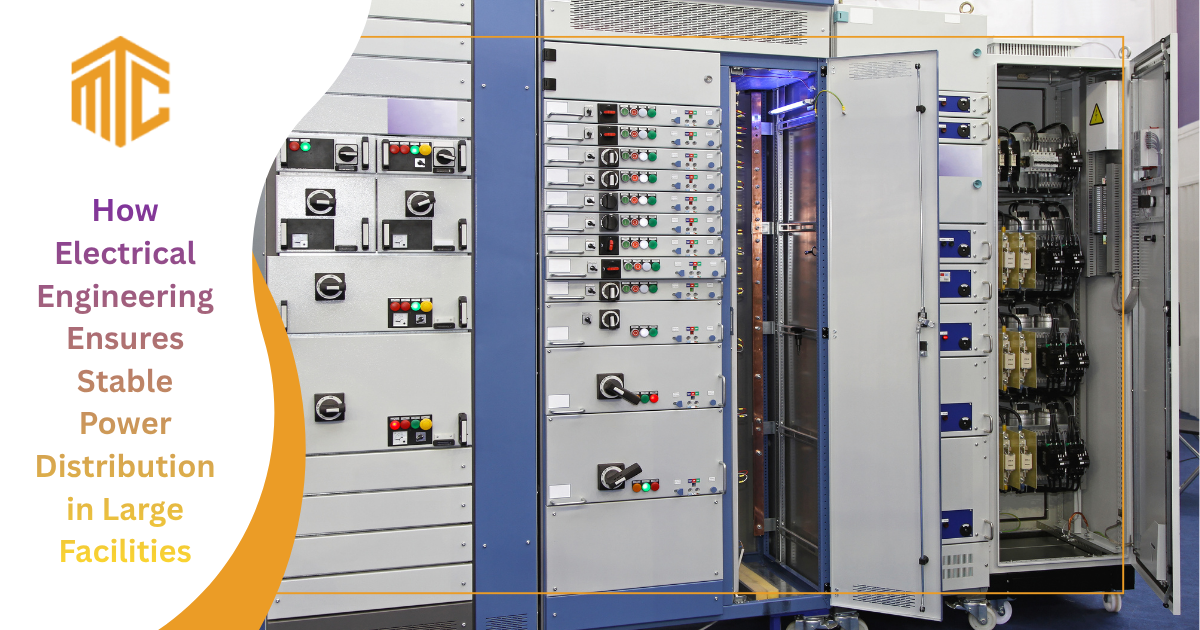
A reliable system includes transformers for voltage control, switch gear for managing flow, circuit breakers for protection, distribution panels for allocation, and busbars that serve as central conductors for efficient transfer.
Benefits of a Stable Power Distribution in Large Sectors
Operational Continuity and Reduced Downtime
A constant power distribution system ensures the maintenance of normal operations without any interruption. Minor shortages in large industries of the medical or manufacturing sectors can result in serious losses. Constant flow of power reduces the chances of disruption, improves productivity, and helps the teams to stick to schedules. This ultimately protects the revenue and the reputation of the organizations.
Enhanced Equipment Lifespan
Constant power supply eliminates voltage variations, which can otherwise cause damage to sensitive equipment. Providing machines with constant electricity will reduce wear and tear concerns. This not only reduces the maintenance expenses but also increases the life span of the system. Thus, organizations can achieve the maximum on capital investments at any given time.
Improved Safety Standards
A good electrical framework helps in improving safety at work. An unstable power supply would lead to overheating, sparks, or failure of a system, which might be dangerous to personnel. Through constant voltage and current, organizations reduce the risks that come along with electrical hazards. This makes the working environment of staff, visitors, and other important facilities safer.
Energy Efficiency and Cost Savings
Effective power allocation minimizes unproductive waste of energy in large facilities. With a slow flow of electricity with no interruptions, the systems can work within the best performance levels. This leads to a reduction in energy consumption, utility bills, and better sustainability outcomes.
Support for Technological Integration
Today’s large-scale operations are based on technological advancements like automation and data systems. Constant power distribution gives these technologies the foundation that they need to operate successfully. It allows the smooth implementation of smart systems, improves the quality of data, and encourages innovations without any danger of power cuts.
Steps Involved in Designing a Stable Electrical System
Assessment of Load Requirements
The first phase is about the proper assessment of the overall electrical load within the facility. Engineers inspect all equipment and operational requirements, analyze the present load requirements carefully. This would ensure the efficiency and reliability of the distribution of power within the system.
System Planning and Layout Design
A detailed layout is created once the requirements of the load are made clear. These involve positioning the transformers, switchgear, and distribution lines. It aims at reducing losses and having a balanced power distribution. Careful consideration reduces the complications in the installation process, as well as ensuring the durability of the system in the future.
Selection of Appropriate Equipment
System stability depends on the correct selection of the components. Choosing the right transformers, cables, circuit breakers, and protection devices should be according to the operating requirements of the facility. Focus on the quality and the compatibility so that the system stays durable, efficient, and safe in its life cycle.
Implementation of Protection Mechanisms
Protective systems play a key role in securing the system against faults, overloads, and short circuits. They are based on relays, grounding systems, and surge protectors. Suitable protection systems will guarantee rapid fault isolation, eliminate extensive destruction, and preserve the entire electrical system.
Testing and Commissioning
The system is strictly tested before it is fully operational. The performance of the engineers is checked under different conditions, which make it stable and safe. Commissioning ensures that every part is operating properly, which helps the electrical system sustain its stable operations.
Different Ways Large Facilities Ensure Power Distribution
Use of Redundant Power Systems
Large facilities have a backup system that helps to let the operations continue even during failures. There is a huge supply of redundant transformers, generators, and parallel lines of distribution. For example, if one system fails, another one is already on stand-by for smooth functions. This will help in eliminating downtime and in easing the continuous running of operations in sensitive environments.
Integration of Smart Grid Technologies
With smart technologies, facilities can monitor and control power distribution in real time. The use of advanced sensors and automation systems is useful in identifying inefficiencies and in reacting quickly to any fluctuation. This preventative strategy plays a major role in bringing reliable results and has more effective decision-making in energy management.
Implementation of Energy Storage Solutions
The use of energy storage systems helps to provide additional stability with backups. They store the excess energy and discharge it when the demand is higher or when there is a failure. This guarantees a steady power supply and balances the load variation, particularly in processes whose energy consumption pattern is variable.
Regular System Upgrades and Modernization
Large facilities are always upgrading their systems on a regular basis just for efficient operations. The maintenance of old equipment is improved by replacing it with modern, efficient systems. Constant modernization will ensure that the system is in line with the change of technology and operational specifications.
Load Balancing Techniques
Load balancing ensures that the electrical load is distributed equally in the system. Facilities can reduce the load on equipment by avoiding overloading in areas to stop failures. This will boost the stability of the system and provide stability in all the working zones.
Maintenance and Monitoring of a Stable Electrical System
Regular maintenance and constant monitoring are necessary to maintain a stable electrical system. Maintenance is based on checking the connections, testing protective equipment, and running the system within acceptable limits. Monitoring systems will provide real-time performance insight to identify anomalies before they develop into substantial problems.
Experienced technicians are also important, as they can interpret data and solve possible threats on time. The predetermined maintenance plans reduce failures and increase the duration of the systems. With the integration of human skills and contemporary monitoring systems, organizations can have uniform performance, enhance reliability, and have an efficient electrical environment in large facilities.
Major Challenges of Power Distribution in Large Facilities
Normally, large facilities experience numerous challenges in power distribution based on scale and complexity. The issue of how to deal with flat and fall loads while ensuring a steady state must be carefully planned and regulated. The operations can face a lot of interruptions due to equipment failures, old infrastructure, and environmental factors. Also, the introduction of new technologies in the old systems frequently poses compatibility problems.
A lot of challenges come up in ensuring safety in large networks. Transmission losses may also affect costs and performance. These issues require constant investment, professional training, and the use of modern surveillance tools. It is important to achieve reliability, better performance, and safety in organizations to operate on a more vigilant basis.
Future Trends in Power Distribution Beyond 2026
Smarter and more adaptive systems are the future of power distribution. There will be an increased use of digital technologies, which will make real-time optimization and predictive maintenance possible. The involvement of renewable energy will also be more noticeable, which will improve flexible and resilient distribution networks.
Localized energy control will be facilitated by decentralized generation of power, such as microgrids. AI will be more in demand to enable forecasting and efficiency. Sustainability will also be one of the main priorities, and it will stimulate innovations in energy storage and conservation.
With the development of systems, reliability, efficiency, and environmental responsibility will become central in organizations. This will create a smarter and more responsive power distribution environment.
Powering the Future with Confidence with MTC
In conclusion, reliable power distribution remains the backbone of every large facility, ensuring safety, efficiency, and uninterrupted operations. Electrical engineering continues to evolve, driving smarter and more resilient systems for the future. With trusted partners like MTC, businesses can confidently embrace innovation while maintaining the highest standards of reliability and performance.
Frequently Asked Questions
What causes power instability in large systems?
Load fluctuations, poor design, equipment faults, and power quality issues.
How do engineers ensure a reliable power supply?
Through redundancy, load balancing, automation, and protection systems.
What role does automation play in power distribution?
It enables real-time monitoring, faster fault detection, and efficient system control.
How can facilities improve energy efficiency?
By using efficient equipment, integrating renewables, and conducting regular energy audits.