
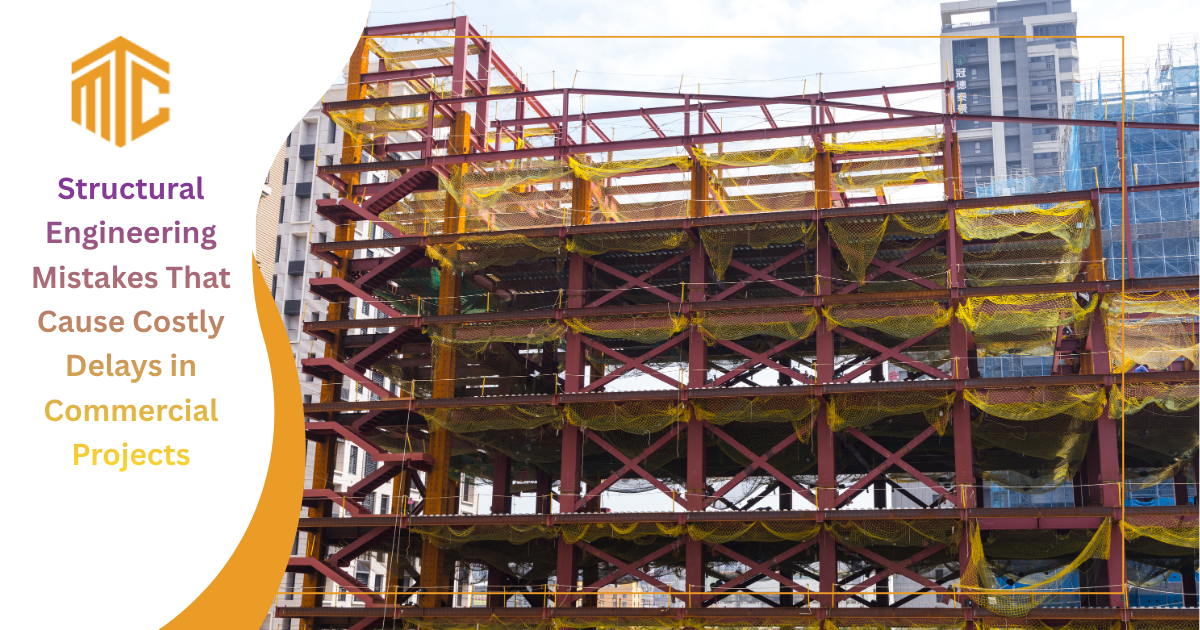
Commercial construction projects are highly sensitive to time, cost, and coordination, where even small errors can create major setbacks. Structural engineering plays a critical role in ensuring stability, safety, and efficient execution throughout the project lifecycle. Common mistakes such as inaccurate load calculations, poor site investigation, and weak communication can lead to costly delays and rework. These issues often result in budget overruns, safety risks, and legal disputes. Working with experienced firms like MTC helps avoid such problems through proper planning, accurate design, and strong coordination.
Inadequate Site Analysis and Soil Investigation
Problem
Poor site analysis and soil investigation take place due to inappropriate geotechnical studies before the start of construction. This often results in wrong assumptions about the bearing capacity of the soil and groundwater conditions. Hence, this leads to foundation redesigns, structural instability and huge undetermined expenses. In certain cases, excavation often stops, which can delay the approval and require so much work to be done during the project timeline.
Solution
Thorough geotechnical surveys should be carried out before the start of the design stage to have a clear knowledge of soil characteristics, load-carrying capacity and groundwater levels. Use the latest methods of soil testing and hire qualified geotechnical engineers to conduct the soil tests. Conduct thorough risk evaluation of worst-case soil conditions to facilitate safe, stable and cost-efficient foundation planning in all project execution phases.
Poor Communication Between Design Teams
Problem
The lack of coordination between structural engineers, architects, and MEP professionals in the development of a project results in poor communication. It causes incompatible designs, e.g. structural beams disrupting ductwork layouts. Consequently, projects are redesigned several times, construction conflicts arise, and gross delays happen. This can add to the costs and affect the structural engineering project execution effectiveness and coordination problems.
Solution
Address communication challenges through integrated project delivery (IPD) strategies that will encourage cross-disciplinary collaboration. Have periodic coordination sessions with structural, architectural and MEP teams to coordinate. Use collaborative tools and centralized communication systems to make real-time updates. Allocate a special coordination manager to manage cross-team integration, minimize conflicts, and ensure design consistency throughout the project lifecycle.
Design Errors and Miscalculations
Problem
Errors in design and miscalculations happen due to mistakes in load calculations, material specifications, or structural analysis during the design phase. The problems are usually brought about by planning a wrong project schedule and the absence of adequate peer review. These mistakes may lead to unsafe structures and poor performance in the structural engineering construction process.
Solution
Implement strict quality control measures and compulsory peer review to remove design flaws and inaccuracies of calculation. Use modern structural analysis programs that have validation checks so that load and material ratios can be accurate. Allow adequate time to make adequate design checks before implementation. Create a culture of responsibility and accuracy among engineers to reduce risks and enhance the overall structural engineering reliability to a great extent.
Incomplete or Ambiguous Construction Drawings
Problem
Contractors usually misinterpret incomplete or wrong construction drawings that lack details, have unclear specifications, or have inconsistent information. This leads to construction mistakes, Requests for Information (RFIs) and project time wastage. These documentation problems can interfere with site workflow, create more work, decrease overall efficiency, and negatively impact project cost, schedule, and quality deliverables at different project phases overall.
Solution
Make sure that construction drawings are very detailed, standardized and clearly displayed so as not to be misunderstood. Carry out comprehensive constructability checks prior to giving final plans to determine possible problems. Use 3D modeling software in order to visualize complicated structural parts. Ensure that there is thorough documentation with clear annotations and specifications to direct the contractors in the right direction, minimize errors and delays during construction execution phases and enhance coordination in general.
Ignoring Building Codes and Regulations
Problem
Violation of building codes and regulations leads to non-observation of local safety standards and legal considerations in the process of structural engineering construction projects. This results in the rejection of permits, monetary fines, and redesign. Delays can be caused by long regulatory approval processes that disrupt project schedules and add costs. It is also dangerous to structural safety, legal approval, and long-term building performance, reliability and compliance concerns.
Solution
Keep updated with local and international building codes to be fully compliant at all stages of the project. Engage code compliance experts at an early design stage to prevent regulatory problems. Do frequent compliance inspections at every construction phase to ensure standards are kept. Assure good documentation and approvals to achieve easy permitting procedures and avoid avoidable structural engineering project delays efficiently at all stages.
Load and Stress Factors
Problem
Underestimation of the loads and stress factors takes place due to dynamic forces like wind, seismic activity and occupancy variations in structural design. Such negligence causes structural deficiencies, overloading, and even safety risks. In certain cases, it involves expensive reinforcement or redesign in construction, and adds to delays, budget overruns, and loss of long-term structural reliability and overall safety.
Solution
Carry out a thorough load analysis which incorporates environmental and dynamic forces like wind, seismic forces and occupancy changes. Use low safety factors in all structural engineering calculations to make sure that it is stable under extreme conditions. It is important to perform stress testing and validation with advanced simulation tools.
Lack of Proper Project Planning and Scheduling
Problem
Poor planning in structural engineering causes delays in the delivery of materials, sequencing errors, and inefficient on-site workflow. As a result, there are bottlenecks, idle labor and project costs rise greatly, affecting the overall progress and productivity in general.
Solution
Prepare elaborate project schedules that spell out structural milestones that are in tandem with the entire construction schedule. Make use of the latest project management software to monitor progress and performance. When planning, always include contingency buffers to provide flexibility to the project to absorb any unexpected delays and ensure a consistent flow of the structural engineering project in all stages.
Poor Material Selection and Quality Control
Problem
Inappropriate choice of construction materials and lack of quality control cause the use of poor or unsuitable construction materials in structural projects. This translates into structural weaknesses, inspection failures and expensive rework in construction. These problems harm the durability, safety and long-term performance of buildings. This, in most cases, leads to delays, higher maintenance expenses and structural failure in the long run over the lifecycle of the structural engineering project in general.
Solution
Indicate high-quality and tested construction material in all design documents to achieve structural integrity. Strict quality assurance measures should be put in place on-site to avoid defects and deviations. Carry out frequent checks and tests of the material being used during construction. Only work with reliable suppliers and vendors to ensure uniformity in standards, enhance durability, and long-term safety and reliability of structural engineering projects overall.
Conclusion
To end with, most mistakes in structural engineering can easily be prevented through clear communication, right usage of technology and careful planning. Taking proactive precautions helps in reducing costs, saving time and protecting the project’s value. Companies like MTC focus on using strong engineering practices for a smoother, faster, and more successful commercial construction projects.
Frequently Asked Questions
How do structural engineering mistakes cause delays?
Mistakes will lead to rework, redesign, permitting problems and construction delays or shutdowns, which all delay projects and add costs.
How do you use technology to avoid mistakes?
Tools such as Building Information Modelling (BIM) and simulation help identify design conflicts, enhance design accuracy and improve communication.
Why is communication important in structural engineering projects?
Inadequate communication results in design conflicts and misinterpretations, leading to errors, delays and cost.
What can project managers do to limit risks in structural engineering?
They can develop risk management strategies, regularly review the project, and facilitate effective collaboration among all parties involved.