
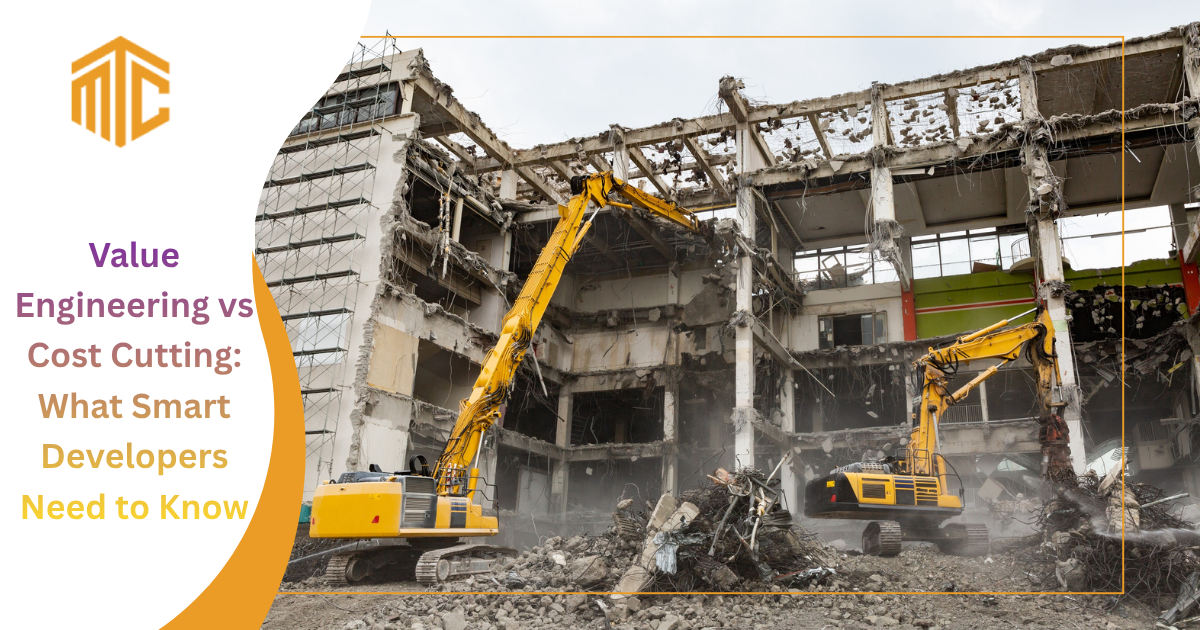
Many developers believe cutting costs increases profits, but this often backfires. With rising material costs, tight deadlines, and constant budget pressure, decisions become risky. The key mistake is confusing cost-cutting with value engineering. Cost-cutting reduces expenses without a strategy, often harming quality. Value engineering, used by MTC, focuses on optimizing performance and long-term value to ensure projects remain efficient, durable, and cost-effective without unnecessary compromises.
This guide explains the difference between value engineering and cost-cutting by developers.
The Core Problem — Why Developers Struggle with Cost Decisions
Making cost decisions is a major problem faced by developers since they always have to juggle between the budget limit and high-quality performance requirements. Investor pressure, high market competition and the desire to meet end-user demands all contribute to the temptation to cut costs. This is very common in cases where profit margins are low. Short-term planning is a common issue in many projects in which immediate savings and quick approvals are important. Such projects can face a lot of challenges in the form of durability, costs of maintenance and the lifespan of the asset.
Also, decision-makers might have inadequate technical knowledge of engineering requirements, material performance, lifecycle impact and make poor trade-offs. The communication between the architects, engineers and contractors is another issue that makes it even more complex. This would lead to divided decisions, which eventually undermine the quality of the project.
What is Cost-Cutting? (And Why It Often Backfires)
Definition of Cost Cutting
Cost-cutting is a process of reducing the costs of a project through major decisions like selecting less expensive materials, cutting labor, resources or scope. Although these measures have the potential to reduce the initial costs, they also affect the overall quality of the project, its performance, and sustainability.
Common Cost-Cutting Practices
Some typical cost reduction measures in projects are the use of low-grade or less durable materials, reducing set safety margins and corner cutting in the design or planning stages. Organizations can also outsource to less experienced or cheaper contractors to cut down on costs. Though such strategies save costs in the short run, they might cause increased risks and undermine reliability and long-term results.
Significant Benefits to Know
The short-term benefits of cost reduction may look appealing, because they result in reduced initial costs and also the project appears cheaper. Such reductions are also capable of accelerating the process of approvals and relieving stakeholders of temporary budget burdens. These short-term profits can, however, be at the cost of quality, durability and increased future maintenance or repair costs.
Definition of Value Engineering
Value engineering is a methodical and organized process of improving the functionality of a project and reducing unnecessary expenses. It concentrates on finding effective alternatives which do not affect or reduce quality. Hence, it makes sure that all the parts serve without contributing unnecessary cost or reducing the overall performance.
Key Principles
Value engineering focuses on several important principles, such as thinking about the functions and the purpose of every part. It also includes lifecycle cost analysis, which assesses long-term costs and not initial costs. Moreover, it also fosters innovation and optimization, as well as collaboration across a variety of disciplines to come up with balanced, effective, and quality project solutions.
How Does It Differ from Cost-Cutting?
In contrast to cost-cutting, value engineering involves maximizing the total value and not just lowering the price. It explores other solutions that offer the same or better performance without undue cost. This strategy places an emphasis on long-term efficiency, durability and effectiveness so that savings are not at the expense of quality, reliability, future operating and maintenance expenses.
Key Differences Between Value Engineering and Cost Cutting
Strategic vs Reactive Approach
Reduction in costs is a smart approach used when budgets are constrained or when there is a financial strain. Conversely, value engineering is a proactive and strategic process that considers functions, materials, and processes at the initial stages. This will help to maximize the value and follow the overall project objectives and performance goals.
Short-term vs Long-term Impact
Cost reduction is mostly aimed at attaining short-term financial savings at the expense of future performance, maintenance or durability. Conversely, value engineering focuses on long-term value by focusing on the lifecycle of a project. Thus, the choices made today will result in cost efficiency, reliable results and better operational performance in the long term.
Quality Implications
Reduction in cost often leads to poor quality through specification, poor material use, or removal of features. This usually results in impaired performance. Value engineering, in its turn, is designed to preserve or even improve quality through a keen analysis of options. This helps to provide the same or improved functionality, making sure that efficiency in cost does not come at the cost of performance.
Risk Management
The reduction of costs can also lead to more risk through the elimination of safety measures or ignoring the essential elements of design and implementation. Such shortcuts may cause failures or unforeseen expenses in the future. Value engineering, though, is an active process of risk reduction through a thorough analysis of alternatives and efficient design.
Collaboration Level
Cost reduction decisions are usually isolated and taken by a small team that is concerned with financial limits, but not the general value. Value engineering, on the other hand, is a cross-functional effort that involves the participation of design, engineering, procurement and operations experts. They collectively come up with innovative solutions to balance cost, performance and functionality.
Comparison Table of Value Engineering vs Cost Cutting
Aspect | Value Engineering | Cost Cutting |
Definition | A systematic approach to improve value by optimizing function vs cost | Reducing expenses quickly, often without detailed analysis |
Focus | Maximizing value (function + performance relative to cost) | Minimizing cost only |
Approach | Analytical, structured, and function-oriented | Direct, often reactive |
Quality Impact | Maintains or improves quality | May reduce quality |
Long-Term Effect | Sustainable savings and efficiency | Short-term savings, possible future losses |
Innovation | Encourages creativity and alternative solutions | Usually limits innovation |
Decision Basis | Function analysis and lifecycle cost | Immediate financial pressure |
Smart Value Engineering Solutions by MTC
MTC plays a key role in improving the overall project value through efficient and cost-effective engineering designs. Our team will analyze designs and construction techniques to seek superior solutions for reducing costs without compromising quality or safety. We often propose smart materials, simple designs, and better building methods that can save time and money.
Moreover, we also use modern tools such as BIM to identify the problems at the early stages and prevent costly changes in the construction process. This assists customers in making superior decisions in the initiation of a project. On the whole, MTC is aimed at providing practical and high-quality solutions that help to cut waste, enhance performance and add value to construction projects.
Conclusion
In conclusion, while cost-cutting may offer short-term savings, it often leads to higher costs in the future. Value engineering, on the other hand, builds sustainable, long-term value. Developers should think strategically, invest in expertise, and prioritize quality, an approach supported by MTC. Smart development isn’t about spending less; it’s about spending wisely.
Frequently Asked Questions
When should value engineering be implemented?
Implement it ideally during the early design and planning stages of a project for the maximum impact.
Can small projects benefit from value engineering?
Yes, projects of all sizes can benefit from optimized design, materials, and systems.
Is cost-cutting ever acceptable in construction?
Yes, but only when it does not compromise safety, performance, or long-term value.
How can developers ensure successful value engineering?
This is possible by collaborating with experienced engineering firms, using data-driven decisions, and focusing on lifecycle value rather than short-term savings.